There is a school of thought — well-credentialed, deeply earnest, and almost entirely wrong — that places humor at the bottom of the poetic hierarchy. Wit, in this view, is what you reach for when you cannot manage profundity. The joke is the consolation prize. The punchline is where meaning goes to die.
Zappai has heard this argument before. It has been hearing it since the Haiku Society of America formally defined it as “miscellaneous amusements in doggerel verse with little or no literary value.” The form’s response, characteristically, has been to keep making people laugh.
What zappai is — and what it became
Zappai (雑俳) is the oldest, wildest, and most democratic member of the 5-7-5 family. Its name tells the whole story: 雑 (zatsu) means miscellaneous, mixed, uncategorized; 俳 (hai) means comic verse, jester, player. Zappai is, literally, miscellaneous comic verse: the great grab-bag of the haikai tradition, the form that said anything goes as long as it is funny and it fits.
The entire 5-7-5 tradition descends from haikai no renga, the comic linked verse of medieval Japan — itself a ribald, populist reaction against the solemn court poetry of the aristocracy. From the very beginning, the tradition had two impulses: one toward transcendence, one toward laughter. Haiku followed the first impulse. Zappai followed the second. During the Genroku era (1688–1704), as haiku began its long migration toward seriousness — toward Bashō’s frogs and autumn evenings and the weight of silence — zappai kicked off its sandals and went to the market. It became the poetry of merchants, craftspeople, actors, and city dwellers who wanted verse that made them laugh, not verse that made them contemplate the void.
The forms zappai developed were games played with discipline and wit: maekuzuke, a competitive capping-verse contest run like a sporting event with crowds, champions, and prize money; kasazuke and kiriku, linked forms with regional followings; oriku, the acrostic crossword puzzle of eighteenth-century Osaka. And then something remarkable happened. One of the zappai judges, Karai Hachiemon, judging maekuzuke competitions in Edo in the 1750s, chose and published poems with such a distinctive comic sensibility that people began calling them by his literary name: Senryū, river willow. What we now call senryu was, in its birth, simply the zappai that one celebrated judge preferred. Zappai is the parent. The child has spent three centuries pretending it has better manners than the parent. It does not.
The establishment and its discontents
The formal dismissal of zappai by Western haiku authorities was challenged directly by scholars Richard Gilbert and Shinjuku Rollingstone, who pointed out that no such pejorative category exists in Japanese literary tradition. Katō Ikuya, a prize-winning Japanese poet and critic, was more precise: zappai simply means “other haikai schools with a wide variety of uncategorized styles.” One scholar went further, arguing that zappai poems “represent the true legacy of the haikai that Bashō inherited, and out of which haiku developed as an independent art.” Haiku broke away from zappai’s irreverent, populist energy to pursue transcendence. That is a legitimate artistic choice. But it is a departure, not an ascent. The establishment will always prefer the monk to the jester — not because the monk is wiser, but because the monk is easier to take seriously.
The far side of seventeen syllables
Winston Everlast did not come to zappai through scholarship. He came through Gary Larson. From 1980 to 1995, Larson’s The Far Side appeared in nearly 1,900 newspapers worldwide: a single panel, one image, a handful of words, a complete comic universe, operating on a principle indistinguishable from the best zappai — unexpected juxtaposition delivered with perfect economy. Larson never explained a joke. He trusted the reader to get there.
That trust is the essence of comic compression. And comic compression — fitting a setup, a twist, and a landing into seventeen syllables — is the specific discipline of zappai. The form doesn’t give you room to explain. You have five syllables, then seven, then five, and the laugh must be in there somewhere, or the poem has failed. The discipline of the count is not in tension with the comedy; it is the comedy. The joke that lands in seventeen syllables is funnier than the same joke in twenty-three, because compression is itself comic. The syllable count is the comedian’s timing, built into the form.
Comic haiga
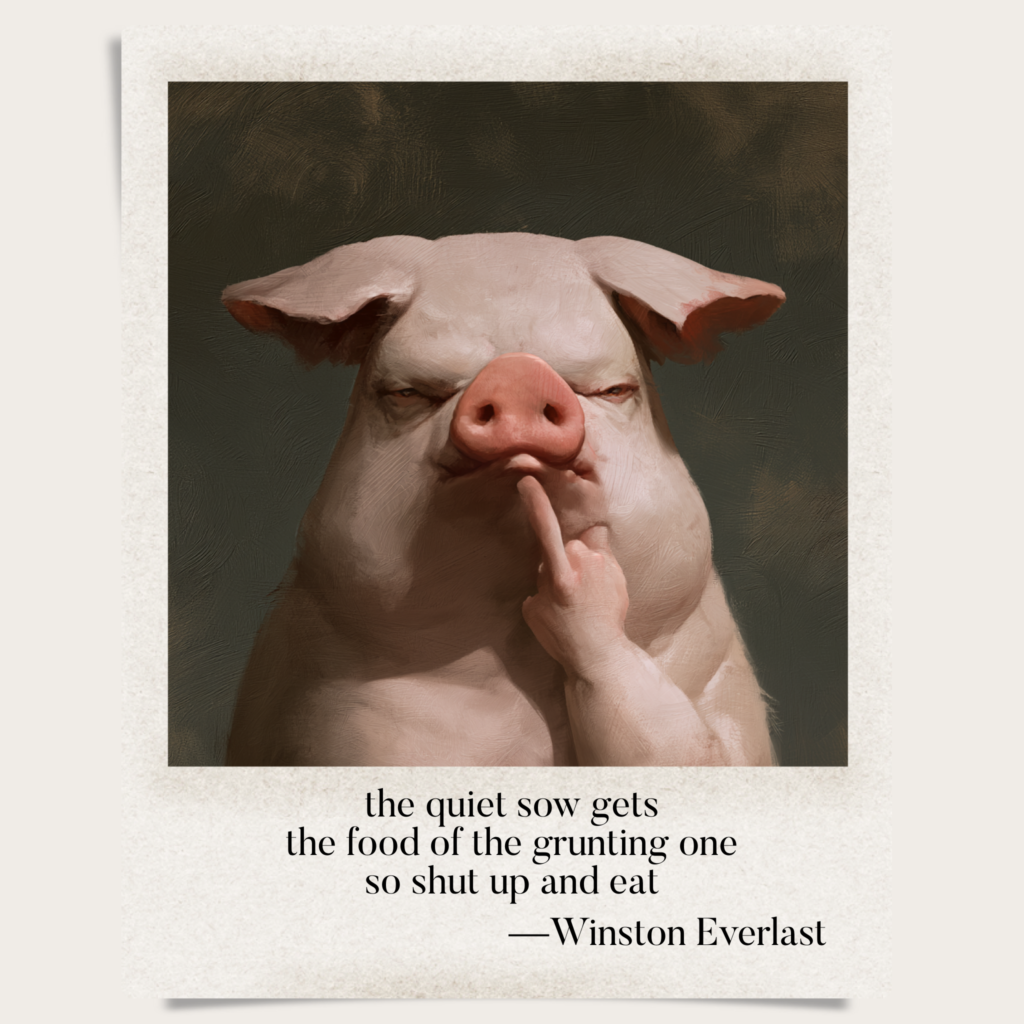
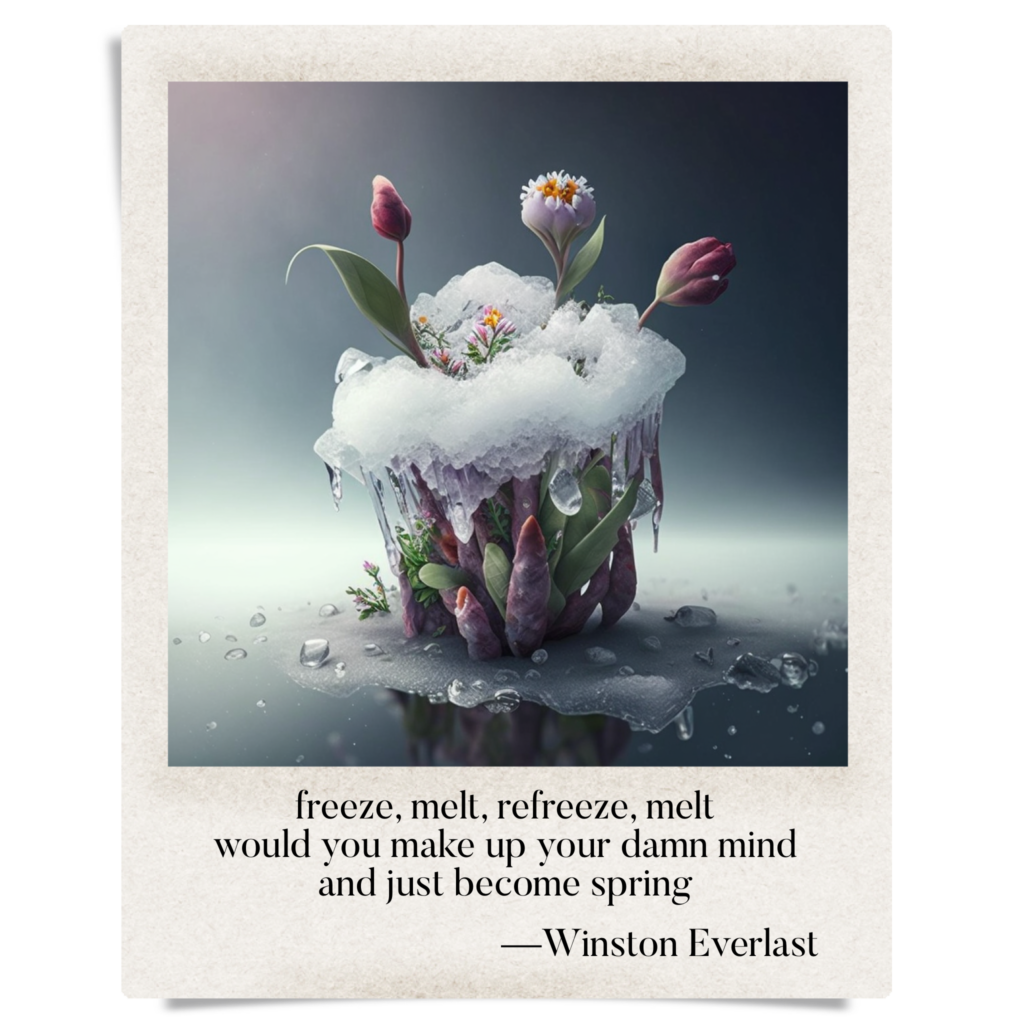
Comic haiga presents an interesting challenge. The image that explains the joke kills it. The image that ignores the joke misses the point. The image that finds the same twist from a different angle — that is the haiga that works. It laughs with the poem rather than at it or past it. Artificial intelligence, it turns out, has a native talent for unexpected juxtaposition: it has absorbed an enormous range of visual and cultural references and can find connections between them that no single human imagination would have made. The AI image-generator and the zappai poet are engaged in the same game — finding the angle the reader didn’t expect, delivering it with economy, and trusting the result.
Gary Larson, we think, would have found this deeply suspicious and mildly hilarious. Which is, more or less, the ideal response.