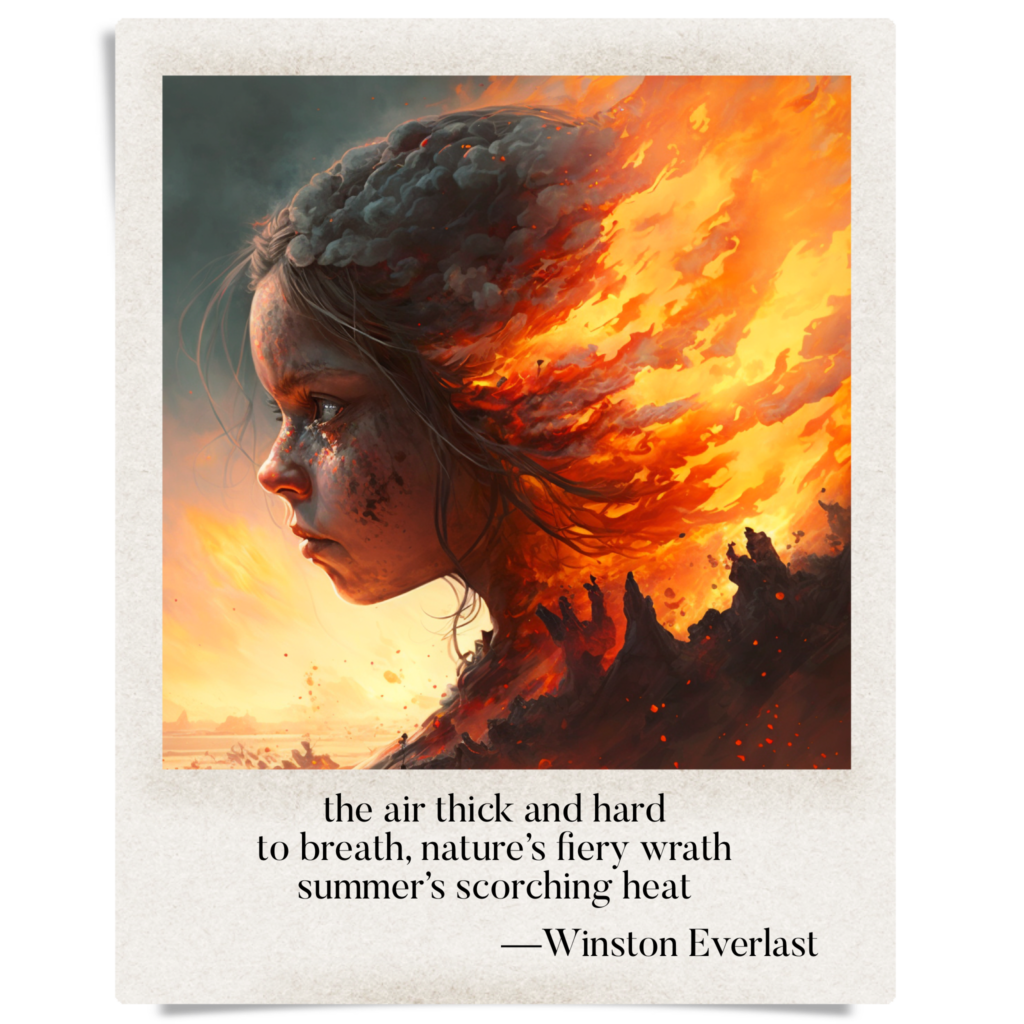
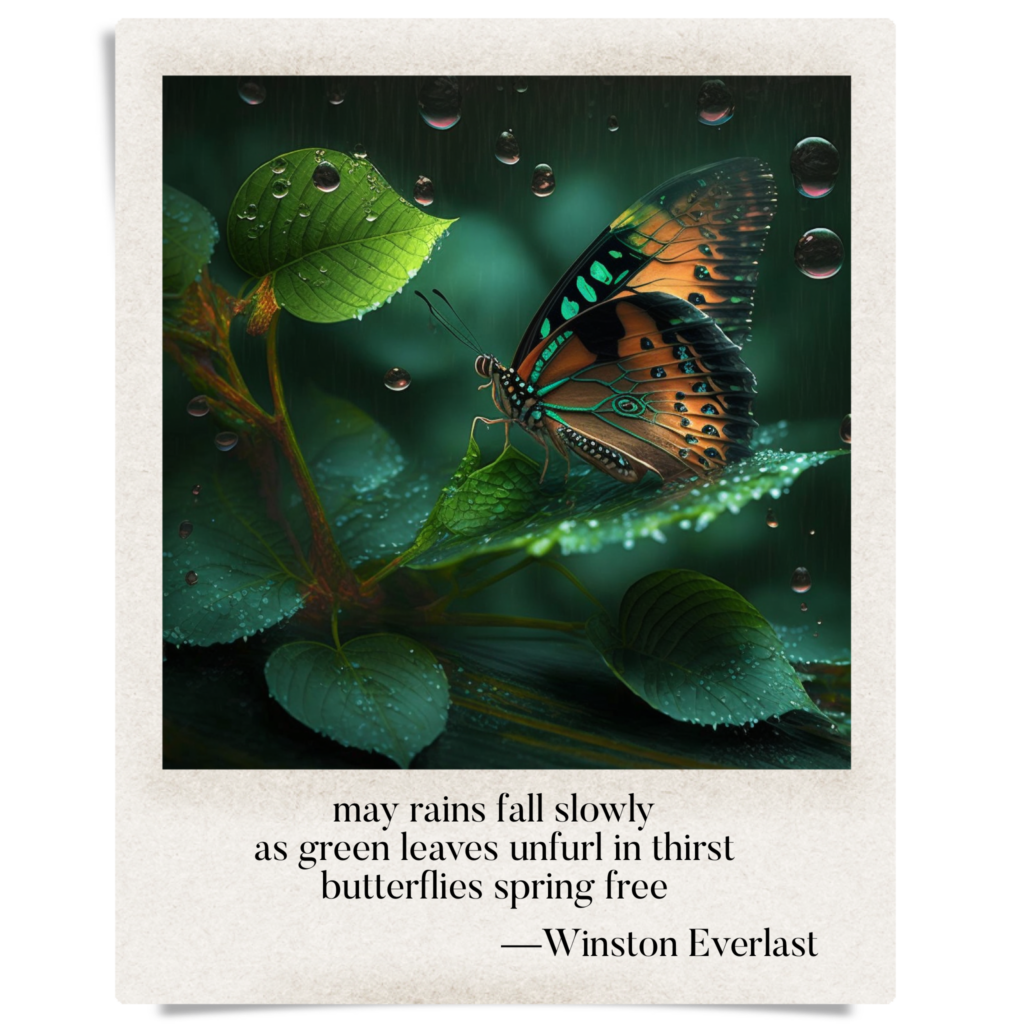
Of the four forms in this collection, haiku is the one that requires the most from its practitioner, and the most honest account of failure. The poems gathered under this name represent Winston Everlast’s most serious attempts at a form that has occupied his imagination since his years at Loras College in Dubuque, Iowa, where he studied under poet Bill Pauly, himself a student of the remarkable Fr. Raymond Roseliep. That lineage matters. But first, the form itself demands introduction, because haiku is one of the most widely misunderstood words in the English language.
What haiku is — and is not
Ask most people what haiku is and they will tell you: a poem of three lines, five syllables, then seven, then five. They are not wrong. But they have described the body without mentioning the soul. True haiku — classical Japanese haiku — requires three elements working simultaneously, each as essential as the syllable count.
The first is the kigo, the seasonal word: a word or image that plants the poem firmly in a specific season, connecting the reader to the living world of nature in its cycles of change. In Japan, entire reference books called saijiki catalog thousands of seasonal words. Cherry blossoms signal spring. Cicadas, summer. Falling leaves, autumn. Snow, winter. The kigo is not decoration. It is the poem’s root system, anchoring the moment in time.
The second is the kireji, the cutting word: a pivot point that divides the poem structurally into two parts, creating a juxtaposition between two images or states. In English haiku it manifests as a dash, a colon, a strong line break — a place where the poem pauses, then turns. The cut is where the meaning lives. Without it, the poem is a description. With it, the poem becomes an event.
The third is the hardest to name: the quality of present-tense immediacy, the haiku moment. The poem must place the reader inside a specific, sensory, happening-now instant. Not a memory, not a general truth, not advice from a distance. Bashō’s frog does not symbolize silence. It leaps into the pond. Right now. You hear the splash. Haiku, in short, is not a short poem about nature. It is a very specific formal instrument for capturing the intersection of human consciousness and the natural world at a precise moment in time.
The formal commitment
In Japanese culture, form is not a container for meaning: it is meaning. The discipline of working within a prescribed structure is itself the art. The contemporary English-language haiku community has largely moved away from the strict count, arguing that Japanese on do not map cleanly onto English syllables and that the “spirit” of haiku matters more. Kerouac’s spontaneous haiku and Ginsberg’s American Sentence are genuine contributions to American poetry. But they are not practiced here.
The argument is simple and drawn from the Western tradition: a sonnet is not a sonnet without its fourteen lines. A villanelle is not a villanelle without its nineteen lines and two refrains. These formal requirements are not obstacles to expression; they are the game itself. The discipline of fitting a complete thought, image, emotion, and moment of perception into exactly five syllables, then seven, then five is the challenge. Removing the constraint removes the achievement. Every poem on this site keeps the count.
The Dubuque lineage
To understand where these haiku come from, one must know something about Dubuque, Iowa: an unlikely capital of American haiku. Fr. Raymond Roseliep (1917–1983) — born in Farley, Iowa, ordained at St. Raphael’s Cathedral in Dubuque, professor of English at Loras College — published over twenty books and twice won the Harold G. Henderson Award from the Haiku Society of America. Critics called him “the John Donne of Western haiku” and “the American Issa.” He promoted what he called “American haiku”: not a departure from form but an insistence that haiku could be written in English with full fidelity to the classical requirements, rooted in Iowa — its skies, its seasons, its bluffs above the Mississippi.
One of the rings of his influence reached Bill Pauly — poet, teacher, lifelong Dubuquan, who came under Roseliep’s mentorship as a Loras student and went on to teach poetry there for twenty-five years, winning the Henderson Award three times. “There’s kind of a lineage here,” Pauly said. Winston Everlast studied poetry under Bill Pauly at Loras College. He is, by any measure, a third-generation inheritor of the Roseliep tradition: Roseliep to Pauly to Winston, three generations of a poetic discipline handed down in the same small Iowa town. That inheritance carries both privilege and obligation — the privilege of having been taught by someone who knew the form from the inside, and the obligation of taking it seriously enough to attempt it honestly.
The honest reckoning
The fifty haiku in the Omnibus were selected from several hundred attempts, judged against every classical requirement: the kigo, the kireji, the present-tense moment, the nature grounding, the two-part juxtaposition, the strict count. Of those fifty, one poem was judged to meet every requirement without qualification. One. Haiku demands something different from the poet’s other registers: the emptying of the self, the willingness to observe without opining, the patience to let the frog be a frog rather than a metaphor. Bashō wrote tens of thousands of verses. A handful became immortal. The ratio is the point.
Bill Pauly once said: “A good haiku will reward repeated readings. Like most poetry, it’s a matter of feeling. It’s an emotional vehicle. And it invites the reader to participate in that experience.” That invitation stands.