I’m Afraid To Cry
· Winston Everlast
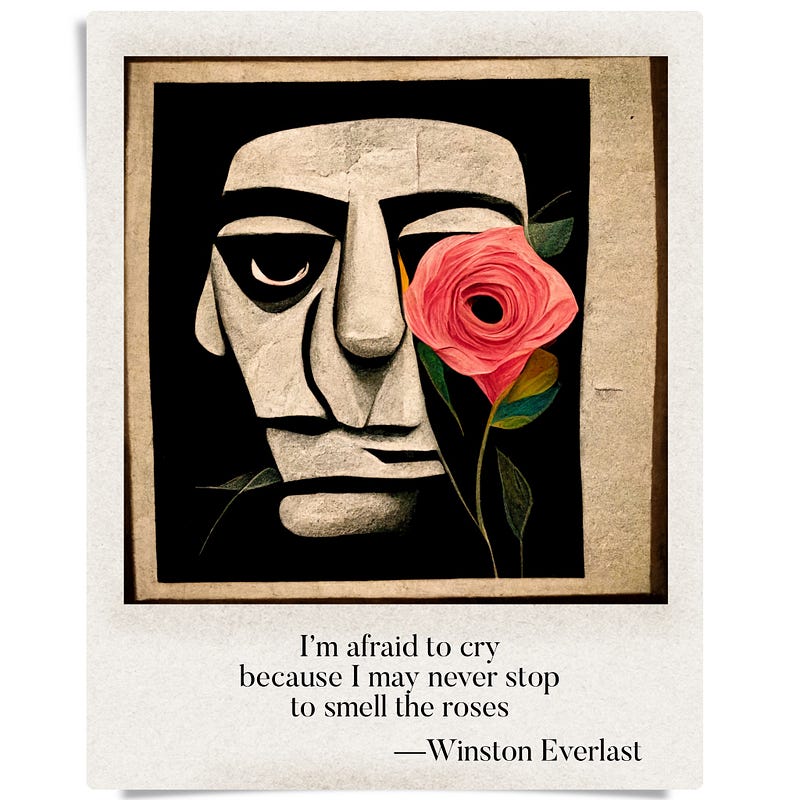
This was the first haiga I composed. In many ways it is the most honest, both in terms of poem and image. I still consider it one of my best because it manages to go from a senryū form to a haiku form within the same poetic structure.
First, let me discuss the haiku as that is more commonly understood. There are many definitions of haiku, here’s mine:
- Seventeen syllables
- Three lines, in a 5–7–5 format
- Contains a kigo which is a word or phrase that evokes a particular season
- Contains a kireji which creates a pause or break in the poem’s rhythm and/or juxtaposes images
It is generally accepted by poetic scholars that Matsuo Bashō (1644–1694) is the creator of what we now call haiku. His most famous haiku is his “old frog” one, which is so simple yet complex, there are at least thirty-two different translations of it and everyone agrees, none are quite right.
Senryū share the same syllabic structure as haiku (5–7–5), but they lack both a seasonal reference and the typical cutting word. Instead, they:
- are about different aspects of humanity
- are often are cynical, sarcastic, or somehow humorous
- are supranatural
It is rare to find a poem that manages to merge from a senryū to a haiku, primarily because most poets strive to keep them in one camp or another. So the challenge with this poem was to figure out how to make them both work. Again, the poem:
I’m afraid to cry
because I may never stop
to smell the roses
The first line of the poem, “I’m afraid to cry” is pure senryū, directly referencing two extremely strong emotions: being afraid and crying. There is an added twist of foreshadowing, with the reader wondering why the author is afraid. Is it because they are afraid of the crying itself or if they are caught crying by someone else? It the author “fearful” to cry or merely hesitant? The reader doesn’t know, which creates a question to be resolved. There is a subtler secondary question as whether the “cry” means “to weep” or more cry as in “to call out.”
The second line of the poem, “because I may never stop” answers the question why is the author afraid to cry. They are afraid to cry because they may never stop crying. An endless cry. Perhaps they haven’t cried in years or even decades, with pent up anguish and grief. Or maybe they are afraid to start crying at all of the injustice in the world, the poverty and hatred we have for one another these days. So the line contrasts an interior explanation with an exterior, the self versus society. Again, often a subject with senryū.
The enjambment of the word “stop” also gives it even more power. It ends the first image or part of the poem. It echos to the haiku’s kireji which creates a pause or break in the poem’s rhythm and/or juxtaposes images. The word “stop” makes the reader do just that, setting up for haiku’s kigo or phrase that evokes a particular season. The third line, “to smell the roses” delivers that season.
Roses typically bloom between late spring and early fall. So the seasonal reference in the poem, as required by the haiku form, would be that time of year. Also, “to smell the roses” invokes a very specific action, and draws a scent from your memory as to what a rose smells like.
But the echoes of the “stop” from the line above continue, as “stop to smell the roses” has an idiomatic meaning of slowing down and appreciating the beautiful things of life. It is a commentary on life, and answers the question as to why the author was afraid to cry. For if they started to cry, they wouldn’t be able to appreciate the beautiful things of life. Remember Life is Beautiful.
As for the image, I used the third version of the generative AI known as MidJourney to create the image. The poem was the prompt, with only the addition of “in the style of Picasso.” Picasso has an extremely recognizable style that, along with George Braque, created one of the most influential visual art styles of the early twentieth century. Picasso refused to depart Paris during the war and refused to deny his art, suffering specific harassment by the Gestapo. Last, while Picasso was best known as a painter, his art also included ceramics and poetry which are two interests of my own. So it seemed natural to use him as a reference in composing the style I was looking for.
Leave a Reply