Fire & Bone — Chapter VII
· Winston Everlast
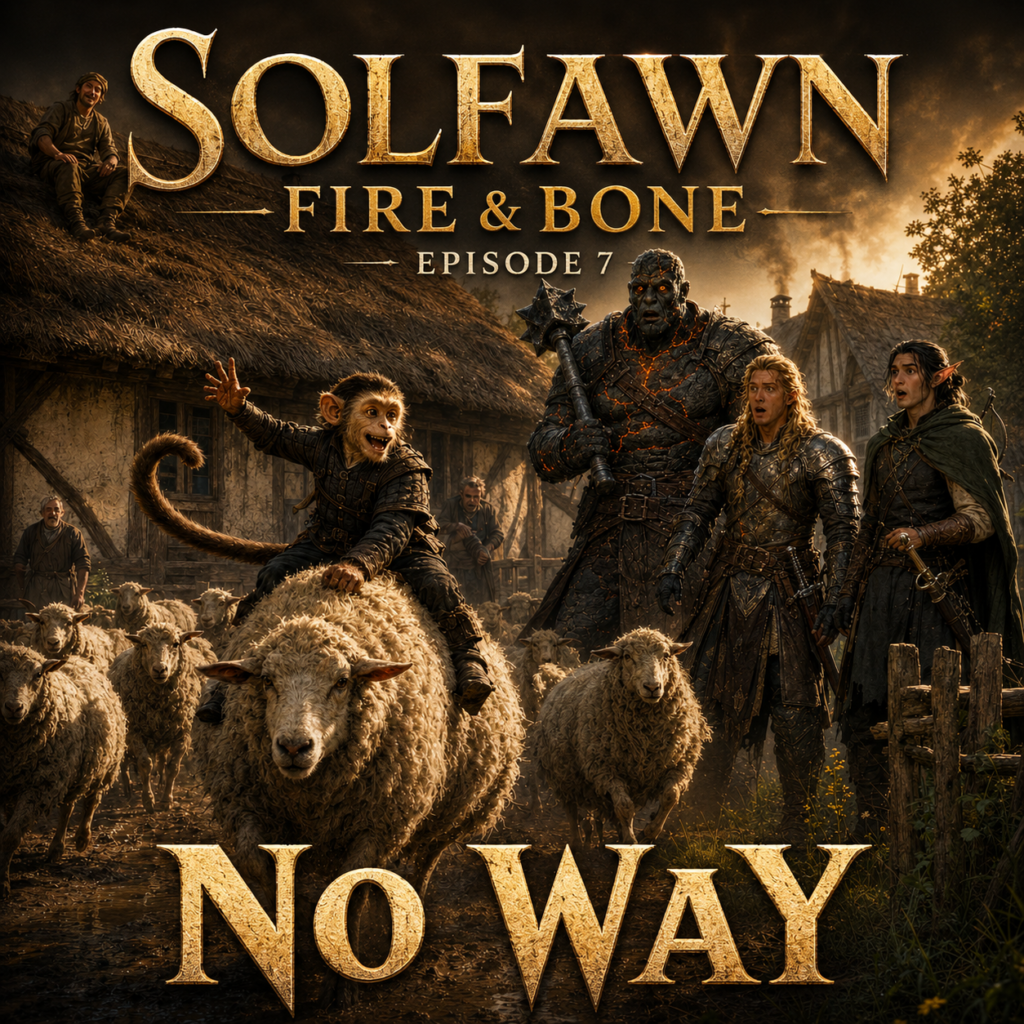
Listen along: Read by Winston Everlast · The Solfawn Deep Dive
Fishbrook left with them. Not the city itself. Fishbrook had too many broken roofs, crowded yards, and arguments about ownership to travel anywhere. But thirty wagons rolled from its northern gate soon after Halen’s Heroes, each loaded with the harvest of the slaughterhouses and bound for villages that had spent the summer raising what autumn would carry away.
Apple watched the first wagon pass. Then the second. By the sixth, he climbed onto a milestone to see whether the line had an end. “Why are they not walking the cattle?” he asked. “Because the cattle are dead,” Sebastian said. Apple looked at him. “I understood that part.” The wagons had been covered with fitted canvas, their seams tied down and marked with blue chalk. No blood leaked between the boards. No flies followed. The drivers wore clean aprons over their traveling clothes, and the draft horses showed none of the unease the smell should have caused.
Wyn let his sight loosen. Magic lay over every wagon in a pale, close-fitting skin. It did not make the meat cold. It held the moment of cutting around it, slowing rot, dulling scent, and discouraging anything too small to understand why it had been refused.
“Preservation wards,” he said. “The cargo will travel for days without spoiling.”
Apple considered the wagons again. “Could they do that to pie?” “Almost certainly.” “We should return.” Sebastian kept walking. The morning was cool enough that breath showed in the low places. Early fall had reached the valley without announcing itself. Green remained in the grass beside the road, but the fields had gone gold and brown. Sheaves stood in ordered rows. Families moved through barley with hooked blades while children gathered what the cutters missed. Carts heavy with squash, apples, roots, and late beans joined the road from smaller lanes, traveled beside them for a mile, then turned toward villages or river docks.
Harvest made everyone hurry before winter could disagree. Everyone except Halen. Heat rolled from him in visible waves. He had spent the previous day beside the Emberkin egg, filling Isca’s memory with instructions and his own with reasons not to follow her east. Now the egg was behind them, secured for the caravan that would leave at noon. The greenglass witness ring circled one stone finger.
Every few minutes, Halen touched it. The ring did not answer. “If you keep checking,” Apple said, “it will not make tomorrow arrive sooner.” “I am not checking.” “You touch it whenever you are not checking.” Halen lowered his hand. The day warmed as the sun climbed, though not enough to justify the glow along the seams of his neck. He had taken too much heat into himself while opening the Glarus chest. Some remained caught beneath his stone plates, slow to leave and impossible to ignore.
Sebastian had declared the weather pleasant. Wyn had agreed. Apple had asked to ride in a preserved wagon. Halen called all three of them unhelpful. The road followed the river north through country built around water. Low fisheries stood in the shallows behind woven barriers. Mill wheels turned beneath timber houses, their steady groan carrying across the fields. Small villages gathered wherever a bridge, ford, mill, or useful bend gave people a reason to stop walking.
They passed Redlark before midday. Its roofs clustered around a red-stone bell tower, and strips of dyed wool hung from lines beside the river. From Mindoro Point, the road climbed high enough to show the valley behind them.
Fishbrook had become a dark interruption in the distance. The land between looked peaceful. Wyn knew better than to trust distance.
By early afternoon, the meat caravan had fallen behind. The road narrowed between a stand of alder and a field where sheep had eaten the grass nearly to dirt. Three young people stood in the center of the road.
They were staring at what remained of a fourth living thing. Wool clung to the low branches. Blood painted the road. Something pale and wet had landed in the ditch. Apple stopped. “Was that a sheep?” The girl nearest the mess turned toward them. She was perhaps twenty, with brown hair tied beneath a plain scarf and both hands pressed over her mouth. Two young men stood beside her. One had blood across his shirt. The other held a length of broken lead rope.
“Maple,” the girl said. The young man with the rope looked down at the remains. “Maple died.” “We can see that,” Apple said. Wyn’s wand began to vibrate. He had carried it inside his coat since taking it from beneath Myra’s mattress.
The pale bone grip had always felt too willing in his hand. Now the spiral along its shaft trembled against the fabric with a pulse that matched nothing around them.
Once. Again. Then the Veil touched the edge of his attention. Not a voice. The Veil did not waste itself on words when absence would do. Wyn felt a narrow place in the world. A fold. Something present by the shape of what refused to be seen. There is a secret here. He drew the wand. The three young people noticed. Their grief did not change, but it became aware of him. “What happened?” Wyn asked. The young man with blood on his shirt swallowed. “It exploded.” “She did,” the girl said. “She was standing there, and then—” Her hands separated in a helpless gesture.
“Had Maple eaten anything unusual?” Wyn asked. All three looked toward the field. “Grass,” the second young man said. “A sheep eating grass,” Apple said. “Suspicious.” Sebastian ignored him. “Any strangers through here?” The girl hesitated. Wyn watched the hesitation rather than her face. “About a week ago,” she said. “A man came through.” “What man?” “Handsome,” she said too quickly. “Elegant. He spoke well.” The young man holding the rope glanced at her. “He did,” she insisted. “Name?” Sebastian asked. “Malvick. Something like that.” Apple’s tail stilled. “Malrick?” The three looked at one another. “Could have been,” said the bloodstained young man. “He looked at the animals,” the other added. “Fed some of them.” “Fed them what?” Halen asked. The boy’s mouth twitched. Not with fear. Halen had been mocked often enough to recognize the effort required not to laugh at him. The realization cooled nothing inside his seams. “What is funny?” he asked. The three faces became solemn. Too solemn. “Nothing,” the girl said. Halen looked at their clothing. Rough shirts. Mended trousers. A faded wool skirt beneath the girl’s apron. Then he looked down. Their boots were excellent. Not new. Better than new. Broken in without being worn down, made from dark, oiled leather with close stitching and soles meant for long miles. No shepherd in the field beyond wore boots worth half as much.
“Are there more animals?” Halen asked.
The young man with the rope pointed north. “Split Birch. Just up the road.” “We should continue,” Apple said. The Veil tightened around Wyn’s attention. The secret remained. “One moment.” Wyn raised the wand. Magic opened. The blood on the road became more than blood. Thin red strands glimmered between the pieces of the sheep, each fading toward the same residue Wyn had seen in the altered-creature tower. Early work. Cruder than the Bristlemaws. Less stable. The creature had carried one of Malrick’s red variants until whatever held it together had failed.
But the sheep was not the only thing shining. Faint magic clung to all three youths. It flowed around their bodies in smooth surfaces, too even to be natural and too shallow to be protection. Illusion. Wyn lowered the wand. “You did not come here with Maple.” The girl’s hands fell to her sides. “No,” she said. The bloodstained young man smiled. “Our master has nothing to fear,” he said, “if this is any example.” The cheap clothing disappeared. The illusion did not break with light or smoke. It simply stopped being obeyed.
Rough cloth became fitted gray coats reinforced at the shoulders. The girl’s apron narrowed into a dark green sash. Silver fasteners shone at each throat. The blood on the young man’s shirt remained, but the fabric beneath it was fine enough to make the stain look deliberate.
The girl stepped away from the road. “Vanda,” the man beside her said. “I know.” “Sven,” she replied. The third sighed. “Bryan.” Apple drew both daggers. “It is polite that they introduced themselves.”
Wyn moved first. He turned the spiral wand between two fingers and drew a short curve through the air. Light followed the tip—not bright light, but color without source, silver and violet sliding across one another in a pattern the eye wanted to complete.
The shimmer opened between the three agents. Their attention caught. Sven stopped reaching into his coat. Bryan’s mouth opened and remained that way. Vanda stared into the shifting color, one foot lifted above the road. “Now,” Wyn said. Apple was already moving. He crossed the road low, one dagger in his hand and the black talon blade in his tail. He struck Sven across the thigh, turned, and cut Bryan beneath the arm before either could recover.
Vanda’s eyes cleared first. Wyn reached for the inside of her coat. A bone needle appeared between her fingers. He saw the oily liquid on its point and twisted aside. The needle passed close enough to catch one thread of his sleeve. Where it touched, the cloth darkened and curled.
“Poison,” Wyn said. “Useful,” Vanda replied. Halen caught her from behind. One arm closed around her waist. The other pinned both wrists against her body. Rope came from his belt, looped twice, and tightened before she could shape another spell.
Sven threw a gray pellet against the road. It burst. Ashglass tore outward in a glittering cone. Wyn raised one arm. Shards opened his sleeve and scored the skin beneath.
Apple turned his face, but several pieces struck his shoulder and one buried itself beside his ear.
Sebastian entered the cloud. His sword flashed once. Sven’s surprise lasted longer than the rest of him. He fell in two directions.
Bryan lunged with the bone needle. The point struck Sebastian’s breastplate and skated across the metal with a squeal. Bryan tried to recover. Apple came up beneath his arm and drove the talon dagger into his ribs.
Violet runes flared along the blade. Bryan folded around it. Apple withdrew the dagger and let him fall. Vanda drove both heels against Halen’s leg. It should not have mattered. Then a hammer appeared. It formed in the air beyond her shoulder, transparent at first and suddenly iron. The weapon streaked backward and struck Halen across the jaw with enough force to make stone ring.
His grip loosened. Vanda slipped free. She ran. The rope still bound her wrists. She dragged her hands across one another. A line of pale magic passed between them, and the fibers parted as neatly as thread beneath a knife.
“Stop,” Wyn commanded. His voice carried the Veil. The word entered the road from every shadow at once. Vanda staggered. Then she laughed and kept running. Apple stepped into the shadow of the alder. He emerged from Vanda’s. The black talon dagger struck between her shoulder blades. She cried out, spun, and vanished beneath his hand. Apple’s blade passed through an image. Sebastian reached them and cut across the false body. It opened like smoke. “Ahead!” Wyn shouted. Vanda reappeared thirty paces north, already running. Wyn stepped backward into his own shadow. Cold closed around him. For one breath there was no road, no sky, no body—only the narrow mercy of the Veil between one darkness and another.
He stepped out beside Vanda. The spiral wand struck her temple. She fell to one knee, rolled, and came up again. Blood ran through her hair.
She slashed at him with the bone needle, missed, and stumbled farther up the road.
Halen pulled the mace from his belt. “Shaper,” he said, “return what flees from consequence.” He threw. The mace turned once in the air. It struck Vanda between the shoulders. She hit the road and did not rise. Apple ran toward her. “Wait,” Wyn called. Too late. Vanda rolled onto her back. The bone needle remained in her hand. As Apple leaned close, she drove it toward his side. He twisted. The point scored the edge of his armor rather than entering flesh. Apple’s dagger entered beneath her chin. Vanda’s last breath left against his wrist. The wand in Wyn’s hand became hot. Not warm. Hot enough that he nearly dropped it. The spiral along the shaft filled with red light. The Veil pressed close, and for one instant the pieces of the slaughtered sheep, Vanda’s blood, the ashglass, and Halen’s inner fire were joined by lines too fine for ordinary sight.
A voice spoke. It was not Vanda’s. It was not the Veil. Old stone carried the words, as if someone far beneath the ruined streets of Glarus had read aloud and the mountain had only now decided to answer. “The song does not command the fire. The song tells the fire it is not alone.” Then the light vanished. Wyn stood in the road with the wand held away from his body. No one spoke. Halen retrieved his mace. “That is from the documents,” he said.
“You read it?” “Only part. A repeated line.” Apple wiped his dagger on Vanda’s expensive coat. “Does it explain why the sheep exploded?” “No,” Wyn said. “Then I dislike it.” Wyn looked at the wand. “So do I.”
– • • Split Birch had moved onto its roofs. They saw the villagers first: men, women, and children sitting astride thatch peaks, standing on slate ridges, or crowded onto the flat top of the millhouse. Ladders had been pulled up after them. Baskets, blankets, clay water jugs, and one small table had followed.
Then the party saw the animals. Sheep filled the lanes. Goats occupied the common green. Three cows stood patiently beneath a window and looked inside. Chickens gathered around every ladder as if expecting someone to descend with grain and an apology. The animals were not attacking. They were waiting. Everywhere a villager moved above them, heads turned and followed. “Do not come closer!” someone shouted. A sheep stepped toward the sound. Two dozen others followed. Halen drew his mace. “Halen,” Wyn said. Halen threw. The weapon struck the ground in front of the nearest ram. Radiant force rolled outward. Three sheep flew sideways and landed without moving. The village erupted. “Stop killing them!” “Those are ours!” “We said don’t come closer!” Halen held out his hand. The mace returned to it.
“They have you trapped.” “They’re sheep!” “Then come down.” No one did. Sebastian listened to the noise. Not the villagers. The animals. Their lowing, bleating, clucking, and restless movement fell into repeated intervals. No melody. No clear rhythm. But the responses reminded him of Fishbrook—heads lifting together, bodies turning toward a sound, attention passed through a group faster than fear should travel.
He drew one sword. Then the other. Apple backed away. “What are you doing?” Sebastian clicked the blades together. Once. Twice. He began to sing Three Gates Home. Poorly. The cattle in Fishbrook had heard trained musicians, full instruments, and carefully timed bells. The animals of Split Birch received a human noble striking sword edges together and carrying only enough of the tune to make its survival uncertain.
The sheep lifted their heads. Every one of them looked at Sebastian. He continued. The sheep answered. One long, collective baa rolled through the village. Apple stared. Wyn covered his mouth. Sebastian lowered the swords. The sheep returned their attention to the roofs. “It worked,” he said. “You sang to sheep,” Apple replied. “Successfully.”
One of the villagers climbed halfway down a ladder and stopped when a goat approached.
“Sill!” someone called from a roof. The man on the ladder looked back. “I know.” He looked toward the party. “Can you help without killing the rest?” “Who was here?” Sebastian asked. Sill glanced at the animals below him. “Three young travelers. Two men and a woman. Stayed last night. Asked about the flocks. Said they were collecting songs.”
“They will not return,” Halen said. Sill looked at the blood on their clothes and decided not to ask. Sebastian approached the nearest living ram. It watched the roof rather than him. He caught one horn and turned the animal’s head. A small rune had been carved near the base, shallow enough not to bleed and fine enough to hide inside the horn’s natural ridges.
Wyn crouched beside him. The mark carried the same red residue as the exploded sheep. “Here,” Sebastian said. They examined the three animals Halen had killed. One carried a rune cut into the edge of a hoof. The other two had matching marks pressed into the hard growth above the heel.
Halen lifted one of the living sheep beneath its chest. The sheep did not object. It continued looking toward the roof while its legs moved uselessly in the air. Apple took a knife and scraped at the rune. The first line came away as pale horn dust. The sheep blinked. The second line broke. Magic left it in a red thread too thin to remain beneath sunlight. The sheep looked down. Then at Halen. Then it began kicking. Halen set it on the ground. It ran toward the field. “Scrape the marks!” Sill shouted.
Ladders came down. The village descended with files, knives, hoof rasps, wood scrapers, and the courage produced when a problem became work. The party caught animals. The villagers removed the runes. Sheep wandered away. Goats resumed eating things that did not belong to them. The cows beneath the window lost interest in the family inside and went to investigate a cabbage patch.
No one apologized to Halen for shouting. He did not apologize for the three sheep. The space between those decisions remained polite. Apple held a ewe while an old man rasped the last line from her hoof. When they finished, the old man touched two fingers to his brow, then turned the palm outward.
The Simiah greeting was awkward in a human hand. It was still the greeting. Apple froze. Then he returned it. “Where did you learn that?” “Traders,” the man said. “Your people come down for livestock. Copper. Salt sometimes.” “From Ti Temple?” The man shrugged. “Never said. They gave names, but I am old enough to know a trading name when I hear one.” Other villagers joined him. They remembered Simiah visitors in midsummer, moving through the high branches along Greenvale’s edge. Small groups. Careful buyers. They came down when lambs were strong enough to travel and returned before the summer storms.
“This year was different,” a woman said. “Some came in spring. Then another group in summer.”
“Why?” “Didn’t say.” “Were they afraid?” The woman considered. “They bought more salt.” Apple looked north. The road beyond Split Birch followed the river toward trees still hidden below the curve of the world.
– • • The villagers fed them. Payment, Sill insisted, for not killing any more livestock. The mutton had been cooked with onions until it left the bone without argument. Bowls of rice and coarse yellow grits filled the table. Blackberry cream pie arrived last, dark fruit bleeding through a pale top beneath sugared crust.
Apple stared at it. “You have pie.” The woman serving him looked concerned. “Do Simiah not?” “We do now.” The meal became larger as people stopped being afraid of their guests.
Questions moved around the table. They asked Wyn whether he came from the forest. “I did,” he said. “Greenvale?” “North of here.” That answer was true and small enough to avoid everything inside it. An older woman leaned across the table. “We used to see elves along the southern paths. Not often. Enough. It has been years.” “How many?” “Five, maybe six.” “Years?” “Since any stayed long enough to trade.” “Do you know why?” Wyn looked at the waiting faces. He had been away. First from Shen Aethel. Then from the tower. Then from every place that might have required him to explain why the Veil had answered. “No,” he said. The word felt less like ignorance than neglect. They were courteous to Halen. No one sat close to him. When a child reached toward the light in his wrist, the child’s mother pulled the hand back quickly and apologized to Halen rather than explaining to the child.
Halen finished his meal without comment.
Sebastian escaped the table when a leather ball rolled against his boot. Four children waited outside, pretending the kick had been accidental.
He returned it. They kicked it back. Within minutes, Sebastian Bane—who had been trained by Ser Eldric, raised beneath House Valcour, and pursued across islands for dynastic marriage—was arguing with an eight-year-old about whether a water trough counted as part of the goal.
Music appeared. A farmer brought out a fiddle. Someone else found a hand drum. The village had survived its own livestock and discovered that survival was close enough to a holiday.
Apple ate a second slice of pie. Then a third. When they finally left, the woman from the kitchen wrapped another slice in cloth. Apple carried it beneath one arm with the care usually reserved for sacred texts. He lasted ten minutes. “You should wait,” Sebastian said. “For what?” “Until tonight.” Apple took another bite. “Life is short,” he said. “Pie is great.” No one found an answer worth using.
– • • The smell of blood reached them several miles north of Split Birch. Not fresh blood. Sweet blood. Thick and old, warmed by the sun. Wyn stopped before the others saw why. Orange mushrooms grew beside the road in a broad, uneven ring. Their caps were too bright for the season, each swollen and wet-looking. A reddish substance ran down the bark of a nearby tree in slow waxy folds.
Above the mushrooms, a small cloud of spores hung without drifting. “Wet cloth,” Wyn said. “Over your mouth.” Apple swallowed the last of the pie.
“Now?” “Unless you want to discover what the spores grow in lungs.” They soaked strips of cloth from their waterskins and tied them across their mouths. Halen’s was unnecessary, but Apple insisted the group looked more prepared if everyone wore one.
Wyn extended his senses. Magic pulsed beneath the mushrooms. At their center, half hidden by caps, lay a wand. Straight dark wood. Silver wire at the grip. Obvious enough to be found.
Valuable enough to make someone approach. “A lure,” Wyn said. Apple had gone to the tree. He touched the red substance with the end of a twig. It stretched in a glossy thread. “Blood should not behave like wax.” The ground behind him opened. A circular mouth rose from the soil. No head came with it. No visible body. Only layered plates, pale gums, and inward-curving teeth driving upward through roots and grass. The jaws closed around Apple. His armor cracked. Teeth punctured the gambeson beneath his left arm and drove him from the ground. He shouted once through the wet cloth as the creature shook him. “Apple!” Halen roared. Another mouth erupted behind Sebastian. He turned before it closed. Teeth struck his cloak. He cut downward, and the blade rang against the hard plates around its jaw. Apple drove both feet against the creature’s upper mouth. The teeth loosened.
He fell, hit the ground, and rolled into the shadow beneath the tree. He disappeared. He emerged beside Sebastian already striking. The black talon dagger found the soft seam between two mouth plates. Violet light flared. The creature shrieked with a sound too high for its size. Halen’s mace crushed the plate above it. The earth answered.
Soil heaved beside the road. Roots tore. A mouth three times larger rose beneath a curtain of dirt, its circular jaws surrounded by thick armored folds.
“Mother,” Wyn said. Apple looked at him. “How do you know?” “I guessed.” “Guess smaller.” The first creature struck again. Sebastian caught its lower plate beneath one sword and drove the other into the flesh beside its eye. The eye collapsed. Black fluid sprayed across his glove. The creature recoiled. “There!” Apple shouted. “Beside the eyes!” The larger creature lunged at Sebastian. He threw himself aside. Its jaws closed on air and soil. Then the ground trembled. The pulse traveled outward through the road. Sebastian lost his footing. Halen staggered one step. Wyn caught the tree. Apple’s tail wrapped around a branch and held him upright while both feet slid.
The mother reared above Sebastian. Its full weight began to fall. Apple released the branch and leapt. He landed on the armored fold behind its mouth, caught a ridge with his tail, and drove the talon dagger toward the nearest eye. The point struck the edge, slipped, then entered. The creature convulsed. Apple held on for one violent breath. Then it threw him. He crossed the road sideways and struck the tree hard enough to empty his lungs. Sebastian regained his feet beneath the creature. He crossed both swords and cut into the wound Apple had opened. Halen struck from the opposite side. Stone mace met armored plate. A crack ran through the creature’s outer ring. Wyn spoke into the Veil.
Shadow gathered beneath the mother’s jaw and climbed inside it. The creature’s scream changed. Something tore where no blade had entered.
It thrashed between them. The smaller mouth attacked from behind. Teeth closed around Halen’s forearm. Sparks flew where enamel scraped stone. He drove his free hand into the mouth and forced the plates apart until Sebastian cut through the exposed flesh.
The creature collapsed back into its hole. The mother remained. It kept all four of them away through weight, teeth, and the trembling ground.
Sebastian bled from a cut above one eye. Halen’s injured arm glowed through new scratches. Apple’s broken armor hung open along his side. Wyn’s earlier ashglass wounds had reopened beneath his sleeve.
They surrounded it anyway. Sebastian drew its attention. Halen broke another plate. Apple entered through the gap. Wyn filled the wound with darkness. The mother struck until its movements became smaller than its body. Then it stopped. The road settled. Three mouths lay among the torn roots and broken earth. All four heroes remained standing. They did not look victorious. Apple drank half a healing potion, made a face at the bitterness, and passed the rest to Halen. “You need more than half,” Halen said. “You are larger.” “That is not how medicine works.” “It is how bottles work.” Halen drank. While Sebastian cleaned his blades and Apple inspected the ruin of his armor, Wyn returned to the mushrooms. The wand still lay in their center. Nothing had disturbed it.
He approached from the side and used his knife to cut the nearest orange cap at its stem.
The circle closed. What he had taken for separate mushrooms rose together. The entire ring was another mouth, wider than a wagon, its inner flesh buried beneath a thin covering of soil. The orange caps grew from its tongue.
The jaws slammed upward. Wyn jumped. Teeth met beneath his boots with a blast of spores and dirt. The force threw him toward the road. He struck one shoulder, rolled, and came up with the spiral wand already raised.
The buried mouth opened again. It could not follow. Its body remained rooted beneath the mushroom patch, all appetite and patience. Apple came beside Wyn and looked at the wand still resting on the creature’s tongue. “Do you want it?” “No.” “Good.” The trap-mouth slowly settled beneath the soil. Its false mushrooms returned to their places. Spores gathered above them. Within minutes, it looked harmless. That offended Apple. He wanted to kill it. Wyn wanted to understand it. Halen wanted both of them farther from its teeth. Sebastian ended the argument by pointing out that darkness would arrive before any of those preferences became useful. They moved their camp well away from the mushroom ring. Before sunset, Halen and Wyn returned to the dead mother and broke several thin plates from the softer armor around its eyes. Apple watched with exacting attention. His gambeson could be repaired, but the punctures had ruined sections no thread could restore.
Halen shaped the plates against heated stone.
Wyn bound them into the torn armor with narrow lines of magic and every useful stitch Apple allowed him to make. By firelight, the pale pieces curved around Apple’s ribs and shoulder like overlapping leaves.
Apple twisted. Climbed a low branch. Hung by his tail. Dropped. The plates moved with him. “It is ugly,” he said. Wyn tied off the final thread. “You are welcome.”
– • • The road divided beside their camp. The western branch followed the river and bent toward Venom Thicket. The northern branch crossed lower hills before reaching Greenvale. Apple had placed Lyric’s bark-cloth map on a stone between them. Myra’s map lay beside it. Firelight moved over both routes as if the flames were trying to choose.
Sebastian looked at Wyn. “Tell us what waits at the tower.” Wyn remained silent long enough for the question to become heavier. “Training,” he said at last. “Discipline. People who believe those words mean the same thing.” Apple settled beside the fire. Wyn looked west. He could not see the tower. He could see the road that remembered it. “Venom Thicket taught me concealment before the Veil did. How to change the way strangers read a face. How to carry a weapon without declaring one. Rapier. Bow. The uses of poison when an enemy is stronger and the uses of patience when an enemy is merely human.”
Sebastian’s expression tightened at the final word. Wyn noticed. “They hate humans?” Halen asked. “Some do.” “Enough to help Malrick?” “Hatred does not require trust.” Wyn picked up a twig and drew a line in the dirt between the two roads. “Humans live quickly. You clear land quickly, build quickly, have children quickly, forget promises quickly. An elf may watch a border village become a town, a town become a logging road, and the road become an argument that the forest was never there.”
“And elves?” Sebastian asked. “We remember the first cut.” “For how long?” “Long enough to make the grandchildren of the person who made it answer.” Halen watched the two of them across the fire. “That is not justice.” “No,” Wyn said. “It is time.” He looked down at the line in the dirt. “An elf may live three hundred years. A human generation becomes a season to us. But humans have more children. More villages. More axes. Time favors us until numbers favor you.”
Apple touched the edge of Lyric’s map. “So why would the tower not kill Malrick?” “They may.” “Then why are we not going there?” “They may believe helping him accomplishes more.” “More what?” Wyn looked toward the darkness beyond the fire. “Less humanity.” The answer silenced them. Sebastian leaned forward, forearms on his knees. “You trained there. Will they hear you?” Wyn almost laughed. “They will hear every mistake I have made since leaving.” “That was not the question.” “No. They may not.” Halen turned the green-glass ring around one finger. “When you left Greenvale, you made the pact.” It was not a question. Wyn’s hand became still. Apple looked between them. Sebastian said nothing. “I chose to leave,” Wyn said. “The Veil answered the choice.” “Why?”
“Because some knowledge is guarded to keep it safe. Some is guarded to keep everyone else obedient. I ceased believing the people in charge could tell the difference.”
He stood. The fire cast his shadow north and west at once. “I need to ask.” “The tower?” Apple said. “Someone less reassuring.” Wyn walked beyond the camp. The Veil did not require kneeling. Prayer was a human word for making oneself small before power. Elves had other words. Lore Keepers used forms with precise openings and closings, as if dangerous questions could be made safe by grammar.
Wyn used none of them. He entered the dark between two trees and stood where the fire could no longer find him. The night deepened. Sound withdrew first. Insects continued beyond the Veil, but their rhythm arrived from a great distance. Then the trees lost their edges. Then Wyn’s own hands became suggestions at the ends of his arms.
He held the spiral wand before him. “Venom Thicket.” The Veil gathered. “Have they taken Malrick?” No answer. “Have they offered him the tower?” Nothing moved. Wyn closed his eyes. He thought of Master Lodin and shelves built into living wood. He thought of copying histories that described humans as weather: destructive, brief, and beneath moral judgment. He thought of Cyralyn teaching orc children letters while every rule surrounding her insisted those children were the danger.
He thought of the young agents in the road. Our master has nothing to fear. Then he understood the shape of the silence. Wyn had asked whether the tower would choose.
The Veil showed him there was no choice left. Venom Thicket had made it. Not every elf. Not all of Greenvale. Enough. The western road closed inside him. When Wyn opened his eyes, the ordinary night returned slowly. His companions waited around the fire. Sebastian rose. “Well?” Wyn looked west one final time. The tower had trained him. The forest had raised him. Neither fact gave them ownership of what he did next. “We go north,” he said. “To Ti Temple.” Apple’s ears lifted. Halen nodded once. Sebastian watched Wyn more carefully. “And Venom Thicket?” “Has chosen.” No one asked how he knew.
– • • They followed the northern road the next morning. Villages became smaller as Greenvale drew closer. Fields narrowed. Stone walls gave way to split timber fences. At every stop, the same story changed only in detail.
Elves had closed old paths. Hunters had been turned back. Survey ribbons vanished overnight. Trees fell across logging roads where no storm had passed. No one had been killed. Not yet. The humans used that final phrase. The elves, when reported secondhand, used another. Not unless.
Neither side had declared war. Both had begun building the sentences that would excuse it.
They camped near a village where the innkeeper refused Wyn a room until Sebastian paid for two. Halen slept beside the stable because the floor inside could not bear him. Apple slept in the rafters and claimed this made the entire question irrelevant.
At dawn, they climbed the last long hill before Greenvale. The forest appeared. It covered the north. Not a line of trees. A country made from them. Green and bronze crowns spread from east to west, layered across ridges until distance turned them blue. The canopy rose in places where crownwoods stood above the rest, their upper limbs catching morning light like islands.
Four or five miles before the first trees, a village waited at the bottom of the hill.
Earthworks surrounded it. Men and women dug a trench beyond the outer houses. Sharpened stakes lay in bundles beside them. Others drove angled timbers into the ground, their points aimed north.
A guard came up the road to meet them. He carried a spear and wore chain mail over a brown tunic. The armor was well kept, the grip on the spear less so. His attention settled on Wyn. “Malcom,” he said. “Forest’s Edge.” Sebastian gave their names. Wyn gave only Wyn. Malcom waited. The waiting was deliberate. “Aelwynar of Shen Aethel,” Wyn said. The guard’s grip tightened. “North of the tower road.” “Yes.” “Do you agree with your brothers?” Wyn looked past him at the trench. “Which brothers?” Malcom did not smile.
“The ones who say no human enters Greenvale. The ones pulling down our mill.”
“I have not spoken to them.” “You’re speaking to me.” “That does not answer your question.” Malcom looked at Sebastian. “He always like this?” “He is being courteous.” Apple nodded. “It gets worse.” Malcom considered the four of them. His eyes paused on Halen, then Apple, then returned to Wyn. “Lewisa will want to know why you’re here.” “Then take us to Lewisa,” Sebastian said. Forest’s Edge had been built from the trees it feared losing. The houses were solid, mostly timber, many decades old. Carved lintels showed harvest sheaves, deer, river fish, and axes. A central fountain spilled clear water into a stone basin. Around it stood six more guards and a growing number of villagers who had found reasons to remain nearby.
Workers at the trench watched them enter. One spat into the dirt. Another struck a stake harder than necessary. The words behind them were low. Not low enough. Elf-lover. Forest spy. Wyn kept walking. Lewisa met them beside the fountain. She was in her late thirties, with light brown hair pulled back and plain clothes darkened at the knees from work. Dirt lined the creases of her hands. She did not wear a weapon.
She did not need one with so many around her. “I’m Lewisa,” she said. “What do you need from Forest’s Edge?” “Information,” Sebastian replied. “We are traveling to the Elder Tree Monastery.” Wyn looked at him. Sebastian did not look back.
Ti Temple remained safer if strangers heard the name of another destination. “The elves have changed their borders,” Sebastian continued. “We need to know what waits ahead.” Lewisa studied Wyn. “They already know you’re here.” “The guards?” Halen asked. “The trees.” Apple looked toward the forest. “Trees do not have eyes.” “These do.” “All of them?” Lewisa almost smiled. Almost. “Enough.” Sebastian lowered his voice. “Are they attacking the village?” “No.” “Have you attacked them?” Several guards shifted. Lewisa’s expression hardened. “No.” “Then why the defenses?” “Because the answer may change before the trench is finished.” She looked again at Wyn. “We will not tell you our patrol paths, stores, numbers, or what has happened beyond the mill.” “We did not ask for those,” Wyn said. “You would.” “You do not know me.” “That is the problem.” The fountain continued between them. Water over stone. Something ordinary enough to make the tension feel chosen. Lewisa looked at Sebastian. “If you are going north, go. The longer you stand in our square beside an elf, the more likely Greenvale decides we invited him here. The longer he stands beside you, the more likely my people decide he came to count us.”
“We take no side,” Halen said. Lewisa’s eyes moved to the sharpened stakes. “No side is a place people stand before the first body.” Sebastian adjusted his sword belt. “Then we will not add to your difficulty.” He turned. Halen followed. Apple looked at Wyn. Wyn remained beside the fountain for one breath longer. Lewisa met his eyes. Neither apologized. Then he left.
– • • The lumber mill stood at the edge of Greenvale. Or it had. The wheel still turned in the narrow stream. The long timber building beside it was coming apart. Elves worked without hurry. One removed roof boards. Another loosened pegs from the main frame and stacked them neatly. A third unwound the iron fittings from the saw assembly. Nothing had been burned. No tools had been broken. The mill was being dismantled with enough care to prove the destruction was deliberate.
Human axes, saws, and logging chains had been arranged beside the road. Confiscated. Not stolen. The distinction mattered to whoever had placed them there. The elves stopped when Wyn approached. An elven woman stepped from the mill. Her hair was dark beneath a hood the color of wet bark. A recurved bow rested across her back. Green-black markings climbed from the collar of her coat along one side of her throat—not decoration, Wyn knew, but the record of service sworn to a forest boundary.
She addressed him in Elvish. “Name your root.” Behind Wyn, Apple leaned toward Sebastian. Sebastian began translating in a whisper.
Wyn answered in the same language. “Aelwynar of Shen Aethel. Lore-trained under Lodin. Road-bound by choice.” Her eyes moved over his human-cut cloak, Myra’s wand, and the three companions behind him. “Long from the soil.” “Not severed.” “Roots left bare become deadwood.” “Only if the tree refuses them.” Her expression did not change. The other elves had stopped working. None raised a weapon. None moved away from one. “We travel to the Elder Tree Monastery,” Wyn said. “It must be warned.” “Of what?” “An armed company moves toward the Simiah temple. They serve a man named Malrick. He intends to use the Heart Stone in a working that will reach the monastery, this tower, and every human holding across Solfawn.”
The woman looked past him toward Forest’s Edge. “You have heard the human account.” “I have seen Fishbrook.” “Humans penned animals until the animals broke the pens. Now humans blame the hand that opened them.” “The cattle killed seventeen people.” “How many forests have humans killed?” Wyn felt Sebastian become still behind him. “This is not accounting,” Wyn said. “It became accounting when they counted land.” The mill wheel turned. Water knocked beneath it with each revolution. Wyn stepped closer. “Venom Thicket is helping him.” It was not a question. The woman’s eyes sharpened. “You have been gone too long.” “Long enough to recognize a bargain made with a knife.” “The tower makes its own bargains.” “Malrick does not.”
“He offers correction.” “He offers control.” “Control?” She gestured toward the human mill. “They cut the trees. Fence the fields. Breed creatures into shapes that cannot live without them. Then call us cruel for ending the ownership.”
Wyn thought of the sheep surrounding Split Birch. Not attacking. Not free. Following a carved command from roof to roof. “He does not free them,” Wyn said. “He replaces one master with himself.” The woman’s mouth curved. “You speak like a human.” “I speak like someone who saw his work.” “You stand with humans.” Wyn did not look back. He could feel them anyway. Halen, still hot from a child he had entrusted to strangers because those strangers had proven worthy. Sebastian, born to a House that expected obedience and living beneath a false name because he refused it. Apple, carrying the last piece of pie in his memory and a temple’s destruction beneath every joke. His people were in front of him. His people were behind him. The difference had ceased to be blood. “The company marching north will take the Heart Stone,” Wyn said. “They will kill anyone who prevents it.” “They will remove what the Simiah have misused.” Apple stopped whispering with Sebastian. Wyn heard the small sound his claws made against the road. “Misused how?” “They guide power they do not understand. They hide it inside ritual and tradition while the forest suffers around them.” “And Malrick understands?” “Enough to act.” “He is human.”
For the first time, the woman laughed. Her eyes remained hard. Wyn lowered his voice. “He may be a vaeroth.” Sebastian’s translation stopped. There was no human word that held the whole meaning. Blood-hollow. The dead thing that continued by making life into appetite. Vampire came close and lost the warning inside it.
The woman studied Wyn. Then she laughed again. “You return from human roads with human monsters in your mouth.” “Myra Block saw what came back from Grimhallow. She does not believe it was the man who entered.” “A human betrayer gives you a human ghost story, and you bring it to Greenvale as truth.” “I bring uncertainty.” “You bring contamination.” The word crossed the space between them more cleanly than a blade. Wyn had expected it. Expectation did not make it smaller. The woman stepped aside. The trees beyond her stood close together, shadowed beneath the canopy. No path entered them. Wyn knew one would appear if Greenvale wished. He knew another could open and lead travelers for two days before returning them to the place where they began. “Choose, son of the forest,” she said. “Stand with your people, or stand against them.” Around her, the elves waited. Behind him, Sebastian, Halen, and Apple said nothing. No one drew a weapon. That was how close the world had come. Wyn looked into Greenvale. He had made this choice before when he left the tower. He had made it when the Veil answered. He had made it when he followed Malrick instead of sailing for Cyralyn.
The cruelty was not that he had to choose. It was that choosing once never finished the work. “If my people stand between Malrick and Ti Temple,” Wyn said, “then I stand against them.” The woman held his gaze. Something closed behind her eyes. Not surprise. A door. She turned away. The other elves returned to dismantling the mill. Dismissed. Wyn faced his companions. Apple looked past him at the measured stacks of lumber, the silent bows, and the forest that had refused to open. “Well,” he said, “that didn’t go too good.”