Art & AI: Times are A-Changin’
· Winston Everlast
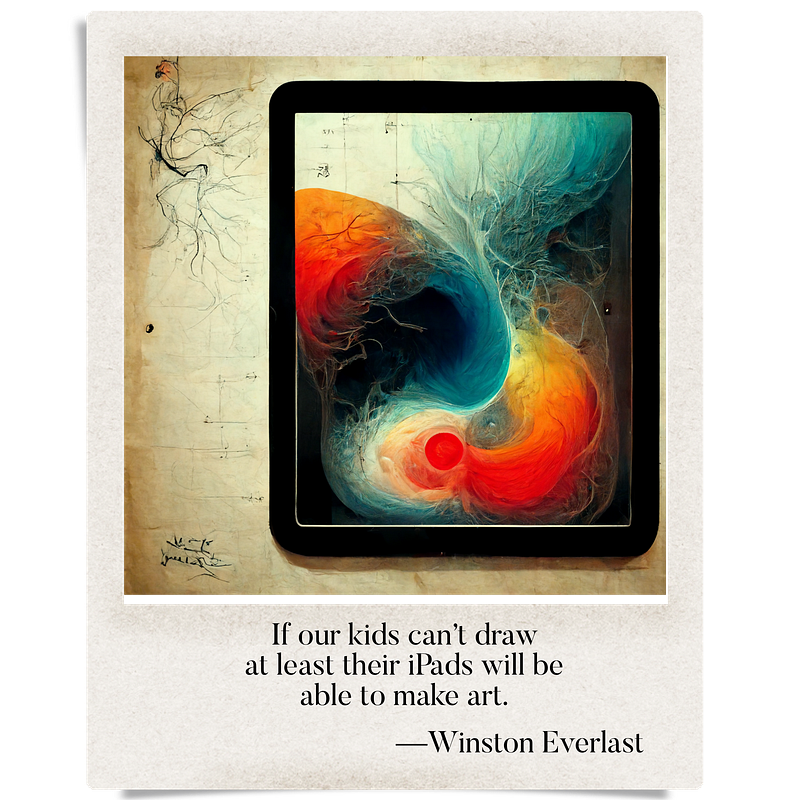
Over on Reddit one redditor posted that everytime MidJourney comes up I honestly get a little panic as an artist. The feeling is, of course, understandable. Since the issue is one that is quite contentious, I thought it only fitting to step right in and add my thoughts to the mix. 😉
Seriously, though, I believe that the poster has a good reason to be concerned. Further, I suspect things are going to get worse before they get better. If David Holz [creator of MidJourney] is even half correct in his assessment of the curent state of AI generated art, the quality of the imagines in 6 months will make the ones of today look childish. So, what should an artist do?
First, I think we should keep in mind the fact that technology has always displaced the leading artistic tech of the day. A common example was the relationship between photographers and painters. When photoshop came on the scene, photographers were against it since it wasn’t “real photography.” And there has always been tension between digital artists and those that use traditional tools. Those technological developments changed the artistic world and undoubtedly put some out of work. But at the same time, it allowed others to enter the artistic world. So, it probably balances out in a general sense. Lose some, gain some.
Second, technology does have an impact on the purchasing public. The fine art that I am most familiar with is ceramics, specifically pottery. I was trained to be a potter while living in Japan and did some shows, etc. I then realized that few people actually purchase handmade pottery. The market had been “destroyed” by entities such as Ikea and technologies such as slip-casting which allowed for mass manufacturing of identical pieces. Look in your own cupboards, you probably have them there. Few people wanted hand made pieces, which while just as functional, weren’t able to be offered for as cheap of a price or as readily as the manufactured ones.
So, what happened to the potter? Well, they are still around as there is still a niche market for handmade pieces. I even know some who make their living doing that, going to shows (where the buyers are) and selling to wholesalers (where the money is). The nature of the market changed and where there were 50 potters, maybe there is only a handful. Or one. Does that mean they stopped making pottery? Some might, but some of us did not stop. We just changed the type of pottery we made. I could not compete with a ceramic factory pumping out dozens of matching dinner sets. But I could take the time to do a unique Raku piece, a one-of-a-kind that wasn’t worth the cost for the large manufacturer.
In a similar way, MJ and other AI-art generators are going to change the current practice of illustrators, photographers, etc. Some are going to lose their jobs. That makes opportunities for others to learn the new skills. And some will continue to practice in the “old way” and find niche markets for their art. You just have to figure out what the niche market is for you.
Last, never underestimate the power of the human connection. True, many people want the cheapest thing they can get. Those people probably aren’t going to purchase your art. In fact, they probably aren’t purchasing it now, anyway. They aren’t into that. But there are others that are impressed that you made something and they have a piece of whatever it is. Maybe it’s a painting or a drawing, or a hand thrown pot. Whatever it is, they value the human connection it brings from your hands to theirs. From your heart to theirs.
One of the interesting things we are going to see with AI generated art is its “perfection.” It is all going to look the same. It’s one of the reasons I’m personally against the — testp and photorealistic push in MJ, it makes everything look blah and samey-samey. But that inaccuracy you mention is at the heart of the Japanese concept of wabi-sabi. Essentially, the imperfection is what makes something beautiful. That is going to be the distinction between human art and AI art. We will make mistakes, they will not. Ours will be beautiful, theirs will be pretty. There is a distinction.
Theirs will also sell a lot more. So, it is in your best interest as an artist to learn what you can about these new tools of creation and discover how to incorporate them into your own creations. There is no guarantee that you’ll be able to make your living making art — but there never really was a guarantee that you would. That’s mostly a fluke. But you can make art everyday of the rest of your life and love it. And maybe people will give you a few dollars or pounds or whatever for it, and you can buy yourself a meal.
Leave a Reply