Fire & Bone — Chapter X
· Winston Everlast
Listen along: Read by Winston Everlast · The Solfawn Deep Dive
Apple felt the road open before he saw it.
The change came through the soles of his feet. The soil beneath the clearing gave a small, settling sigh. Roots drew away from one another. Leaves lifted from the ground and turned their wet faces toward the trees.
Then the wall of green divided.
Morning waited beyond it.
The road was narrower than it had been the day before. Ferns crowded its edges, heavy with dew, and low branches crossed overhead as though the forest had lowered a roof above them. The way was still clear enough to walk.
That was all the welcome Greenvale intended to offer.
Apple climbed onto a root and looked ahead.
No elf stood in the road. No archers showed themselves among the branches. He listened for the scrape of leather, the soft complaint of a bow, or the breath of someone trying not to breathe.
He heard water dripping from leaf to leaf.
He heard Halen fastening his pack.
He heard Sebastian quietly swearing at a knot in one of his straps.
He heard Wyn not offering to help him.
The elves were there.
Apple simply could not hear them.
“It is open,” he said.
“I had noticed,” Wyn replied.
“You were looking the other way.”
“I notice in several directions.”
Apple looked at him. Wyn’s cloak hung unevenly where the missing wand had once been wrapped among his things. His face revealed nothing, which meant he was still angry.
Halen lifted his pack. The movement pulled at the sealed wound in his side, and the light beneath the stone there brightened for a moment. He paused until it dimmed.
Sebastian saw it.
He did not ask whether Halen could continue. None of them asked that question anymore. They asked how fast, how far, and what the rest of them needed to carry.
Sebastian took one of the heavier water skins from Halen’s pack and added it to his own.
Halen allowed him.
They entered the road.
By midday, Apple understood that the forest had not decided to help them.
It had decided to measure them.
The path remained passable, but only just. It climbed over wet ridges and descended into hollows where the air smelled of black soil and old rain. Moss softened the stones until every step became uncertain. Pale fungi opened beneath fallen logs like small listening ears.
Whenever Halen slowed, the road steepened.
Whenever Sebastian moved to take the lead, thorn branches lowered across his face.
Whenever Wyn left the path to examine a marking, the marking vanished beneath fresh bark.
The forest did not trouble Apple at all.
He disliked that more than the others did.
He moved ahead and returned, ahead and returned, never going so far that he could not see one of them. The lower branches were strong enough to carry him, but he remained close to the ground. Nothing in Greenvale happened by accident. If the trees made climbing easy for him, it was because someone wanted to know whether he would leave his companions behind.
He did not.
The day warmed. The wet green smell of morning thickened into resin, bark, and the faint sweetness of flowers growing too high to be seen. Small insects whined around Sebastian’s ears. Halen’s heated stone dried every leaf he brushed, leaving a narrow trail of curled brown edges behind him.
At first Apple worried the elves would call that damage.
Then he decided they could complain to Halen themselves.
They ate while walking.
There was little left: hard grain cakes, two strips of dried fish, nuts, and a bruised pear Sebastian cut into four unequal pieces.
Apple received the largest.
He noticed.
He did not mention it.
Near afternoon, the road changed.
Apple stopped so quickly that Sebastian nearly walked into him.
“What is it?” Sebastian asked.
Apple raised one hand.
At first there was only the forest.
Then he heard the ringing.
It was too low to be a bell and too clear to be stone. One tone trembled at the edge of hearing. A second moved beneath it in a slower rhythm. They touched, separated, and touched again without ever becoming the same sound.
Apple’s tail lifted.
“Metal,” Sebastian whispered.
“No,” Apple said.
He knew the sound.
Not this sound. Not these notes. But he knew what made them.
He stepped off the road.
This time the forest did not close around him.
Beyond a screen of broad leaves stood a stone no higher than his knee. Rain and years had darkened its surface. Three shallow grooves had been cut across its top. The center groove held a line of green glass no wider than a thread.
Apple crouched beside it.
The glass was warm.
He placed two fingers on the stone. A faint vibration moved into his bones, climbed his arm, and settled behind his teeth.
“A listening stone,” he said.
Wyn knelt beside him. “For what?”
Apple looked deeper into the forest.
“Everything.”
Once he knew what to look for, the signs appeared everywhere.
They were not signs meant for human eyes.
Small copper loops had been fitted around growing branches without biting into the bark. Gemstones rested in carved hollows beneath roots: smoky quartz, moonstone, garnet, and green glass polished by years of touch. Fine chains crossed narrow gaps between trees, each one hung with flat pieces of shell that turned in air too faint for Apple to feel.
None of them chimed alone.
Together they made the distant ringing.
The road curved around an elder tree wider than a house.
Its trunk had split centuries ago and healed without closing. Within the long dark opening, Apple saw a staircase.
The steps had not been built into the tree. The tree had grown around them.
Each tread was a different material: gray stone, dark wood, copper, pale shell, red glass. Thin lines of gemstone ran from the stairs into the living trunk, disappearing beneath the bark.
Above them, the canopy opened.
Apple forgot to breathe.
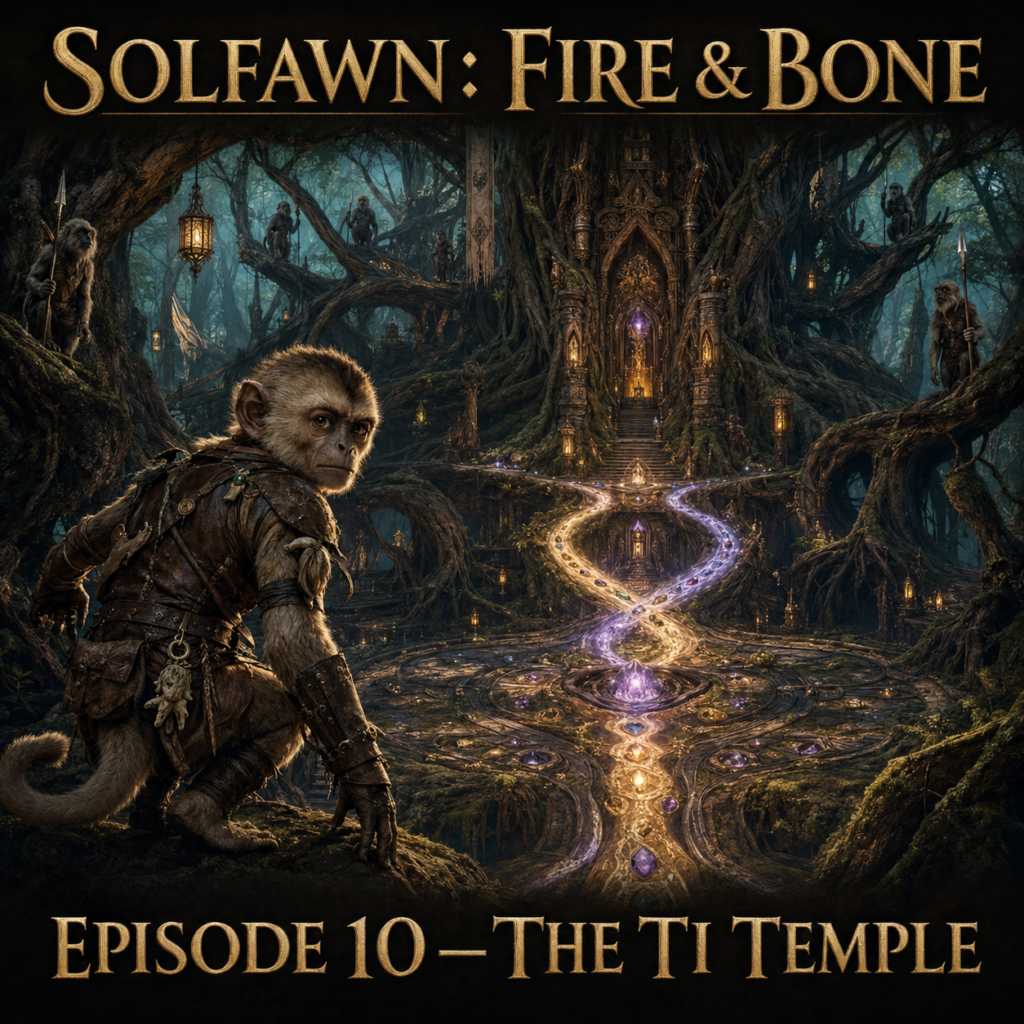
The Elder Tree Monastery did not rise from the forest.
It emerged from it.
Platforms rested within the forks of immense trees, their edges shaped from living branches braided together and allowed to thicken. Bridges crossed the air at different heights. Some were rope and plank. Others were stone paths held between trees with no visible support. Water traveled through open wooden channels, falling from level to level in silver curtains. Small wheels turned beneath the streams. Their axles carried copper arms that touched rows of gemstones as they passed.
Every touch made light move.
Red became gold. Gold became green. Green vanished into the trees.
Far above, houses or workshops curved around trunks beneath roofs of layered leaves and dark tile. Lifts rose and descended on ropes. Apple saw baskets of fruit, bundles of reeds, slabs of stone, and three Simiah standing together on a platform as it climbed.
The air smelled of wet wood, woodsmoke, crushed mint, and hot mineral oil.
Hammers sounded somewhere beyond sight.
Not striking in disorder.
Answering one another.
One blow from the east.
Two from above.
A pause.
Three quick notes from deeper in the temple.
Apple felt the pattern in his hands.
Ru Temple had spoken that way during heavy work. A master at the shrine would call a measure. The bridge workers would answer. The metal workers would change a setting by half a finger. The whole temple had listened to itself.
His throat tightened.
“Apple?” Halen said.
“Ti Temple,” Apple whispered.
Wyn looked toward the nearest platform. “The elves call it the Elder Tree Monastery.”
“That is what elves call the trees.” Apple pointed past the platforms toward the earth beneath them. “The temple is named for the stone.”
He could feel it now.
The Ti Stone—the Heart Stone of this temple—lay somewhere ahead and below, buried at the center of the sanctuary. Two ley lines crossed beneath it. They did not collide. They approached one another, entered the stone, and divided through an array of gemstones set around the heart. The array guided each current around the other and returned it to its path.
It was not a wall.
It was clockwork.
Not clockwork made of gears and springs, though those might be used where a hand needed to adjust what the earth was doing. This was the older clockwork: pressure, color, vibration, stone, water, root, and the patient correction of forces too large to stop.
The Simiah kept it moving.
They tended the magical energy swirling through the world so one current did not grind against another until both became ruin.
Apple had thought Ru Temple was the only place where anyone still remembered how.
He had been wrong.
The relief hurt.
He searched the platforms for damaged rails, broken wards, smoke from cook fires too large for ordinary meals, or the shine of unfamiliar metal.
He saw no human tents.
No boot prints cut the damp earth. No trees had been scored by wagon axles. No horses had stripped bark from the lower trunks. He smelled no boiled leather, no stale sweat trapped beneath armor, and none of the bitter red residue that followed Malrick’s work.
Travis had not reached the temple.
Or he had reached it without leaving any sign Apple could find.
Apple preferred the first possibility.
He did not trust it.
“Do not draw anything,” he said.
Sebastian’s hand was already near his sword. He lowered it.
“Not even if they point weapons at us,” Apple continued.
“That qualification seems important,” Sebastian said.
“Do not touch the stones. Do not step over a red cord. If someone gives you food, take it with both hands.”
“What if it is poisoned?” Wyn asked.
“Then we die polite.”
Wyn considered this. “There are worse epitaphs.”
“Do not look up too much,” Apple said. “It makes guards think you are counting.”
Sebastian looked into the canopy. “Are there guards?”
“Yes.”
He had not seen one clearly.
That did not matter.
A shadow shifted behind a waterwheel. A bridge rope dipped with no visible weight upon it. High above, a pale langur face appeared between leaves and vanished.
They were being watched by capuchins small enough to hide behind branches, langurs whose long arms carried them silently between trees, and larger guards positioned where the platforms could bear their weight.
The party continued.
No one stopped them.
That was not permission.
It was curiosity.
The path climbed around the elder tree, passed beneath a bridge, and turned sharply between two roots.
Three Simiah waited beyond it.
The first was a tall female with long dark limbs and a mantle of pale fur around a narrow black face. Copper and green glass were braided into the wrap across her shoulders. She stood without a weapon.
She did not need one.
The second was the largest Simiah Apple had ever seen outside the ruins of his temple. The male’s shoulders were broad enough to block most of the path. Black fur covered his arms and chest, but silver had begun to spread across his back and crown. A thick spear rested upright in one hand.
A broad silver tail ring shone near the end of his short, powerful tail.
The third stood slightly behind them.
She was younger and smaller than the tall female, with russet-brown fur warmed by gold along her cheeks and hands. Her tail curled once around her ankle and released. She wore a narrow vest worked with tiny blue stones. No ring marked her tail.
Her eyes went first to Apple.
Not to his weapons.
To his face.
Apple looked away from her and found the spears.
There were twelve he could see.
Simiah guards crouched in the trees on both sides of the path. Langurs held the longer spears. Smaller fighters carried short stabbing weapons and slings. Two great apes waited on a platform above, where a single command could bring them down behind the party.
There were more he could not see.
The silvering male looked at Wyn.
His mouth drew back slightly from his teeth.
Then he looked at Sebastian.
The dislike became simpler.
His gaze passed over Halen and paused at the light moving beneath the Emberkin’s stone.
“Elf,” he said.
Wyn inclined his head.
“Human.”
Sebastian did the same.
The male studied Halen. “And something that does not belong in these trees.”
Halen’s inner fire brightened.
“He is Halen,” Apple said.
The male finally looked at him.
His eyes moved over the plated gambeson, the daggers, the hand crossbow, and Apple’s tail.
They stopped where a ring should have been.
Apple saw the judgment arrive.
No tail ring.
No mastery.
No standing.
The male dismissed him so completely that he turned back toward the others before speaking.
“I am Titima,” he said. “Master of the temple defense. This is Savala, keeper of our voice beyond the trees and matriarch of Ti Temple.”
The tall female watched them with eyes that missed nothing.
Titima gestured once toward the younger Simiah. “Our daughter, Lati.”
Lati inclined her head.
Apple did not.
Titima noticed.
“Why have an elf and a human entered Ti Temple armed?”
“Because Greenvale is full of things trying to kill us,” Sebastian said.
Apple heard the honesty leave his mouth before protocol could improve it.
Titima’s grip tightened on the spear.
“Their weapons stay covered,” Apple said. “They are here as my guests.”
The large male looked down at him again.
“Your guests?”
Apple met his eyes.
“I am Saru of Ru Temple.”
Silence moved through the trees.
It did not become complete. The water still turned. The gemstone clockwork still rang at the edge of hearing. But the guards stopped shifting, and every visible face turned toward Apple.
Savala’s head tilted.
Lati’s tail uncurled from her ankle.
Titima did not move at all.
“Ru Temple is dead,” he said.
“I know.”
“Then you are Saru of nothing.”
Only the tip of Apple’s tail moved.
Once to the left.
Once back.
“Did you receive my warning?” he asked.
Savala answered before Titima could.
“A druid brought a scroll sealed with a sacred ring.” Her voice was lower than Apple expected, calm and textured like water moving over stone. “The hand was uncertain. The words were direct.”
“I wrote it.”
Savala looked at him with open surprise.
“You?”
“Yes.”
“A male of Ru wrote the warning?”
“Wyn taught me the letters. I put them together.”
Her eyes moved to Wyn, then back to Apple.
Interest sharpened them.
Beside her, Titima’s expression darkened.
“Ru males worked stone and ward,” he said.
“I also work locks,” Apple replied.
Lati’s mouth moved.
She was trying not to smile.
Titima saw that too.
“You entered beneath elven leave,” he said. “Do you speak for them?”
“No. I speak because they allowed us one chance.”
Apple looked from Titima to Savala.
“The elves have sent their last warning. Leave the temple unharmed and no harm will come to the Simiah. Stay, and everyone here will perish.”
The spears in the trees lowered.
Not toward the ground.
Toward the party.
Titima stepped forward.
“A trap,” he said.
“No.”
“An elf brings a human and a creature of fire into our sanctuary. A ringless orphan speaks the elves’ threat. We abandon the Ti Stone, and soldiers take what remains.”
He began to circle them.
Apple stayed where he was.
“I know humans,” Titima said. “They cut a road, then claim the land beside it because the road requires protection. I know elves. They call a boundary sacred after moving it around what they desire. Now both send you to explain why honor requires us to flee rather than fight.”
He passed behind Halen.
The guards above shifted to keep their spears clear.
“If we leave,” Titima continued, “humans will say the temple was empty. Elves will say the forest reclaimed it. Both will call the theft peaceful.”
He stopped in front of Apple.
“And you tell us to help them.”
Apple looked up at him.
His pulse remained steady.
His hands remained open.
His voice was cold.
“I tell you not to leave your bodies on tables.”
Something changed in Titima’s face.
He looked more carefully at Apple.
His gaze passed over the scar at Apple’s cheek, the repaired cuts on his arm, and the mismatched plates fastened to his armor.
“The seal you sent,” Titima said. “Where did you get a Simiah tail ring?”
“I cut it from the finger of a halfling I killed.”
Titima waited.
Apple offered nothing more.
“You expect that to impress me?”
“No.”
The answer seemed to trouble him more than boasting would have.
Titima circled once more.
This time he noticed the white curve fixed beneath one of the trap-mouth plates on Apple’s armor. The piece had been polished on one side and carved on the other. It held two leather straps together at his shoulder.
Titima reached toward it.
Apple’s hand closed around his wrist.
Every spear moved.
Lati took one step forward.
Titima looked down at Apple’s fingers around him.
Apple released him.
“Ask,” Apple said.
The silvering male’s nostrils widened.
“What is it?”
“A tusk.”
“Whose?”
“Grath One-Eye.”
Titima’s eyes sharpened. The name meant something to him, though Apple could not tell whether it came from trade, warning, or old grief.
“The orc pirate?”
“Yes.”
“How did you take it?”
“He tried to kill me.” Apple touched the tusk with one finger. “I killed him first.”
“You were smaller than this when you did it.”
“Yes.”
Titima studied him for a long moment.
Still he did not look impressed.
That was better.
At last, his gaze moved to the cord around Apple’s neck.
“And the ring you hide there?”
Apple’s fingers closed over it through the gambeson.
He could have refused.
Instead he drew the cord out.
Koruma’s tail ring rested in his palm. Silver caught the green forest light. The deep green stone looked almost black until he turned it.
Savala inhaled.
Titima’s expression became still.
Lati stared at the ring, then at Apple.
“Koruma,” Savala said.
Apple looked at her.
“You knew him.”
“We knew his work.”
Titima bent close to the ring without touching it. “Why do you wear a master’s oath when you have not earned your own?”
The tip of Apple’s tail stopped moving.
“Because he was my father.”
“That does not make his mastery yours.”
“I know.”
“Then why carry it?”
Apple closed his hand around the ring.
“Because the pirates cut it from him. Because I took it back. Because he told me power is something you listen to before you shape it.”
He slipped the cord beneath his armor again.
“And because until I earn my own, I need to remember what one means.”
Titima stood over him.
Apple did not lower his gaze.
For several breaths neither moved.
“Father,” Lati said.
Titima’s head turned slightly.
“Ti custom requires us to invite a Simiah visitor and his guests to the evening meal.”
“He comes under threat.”
“He comes under his Temple Name.”
“His temple is gone.”
Lati looked at Apple.
“Then the name has traveled very far to reach us.”
Apple’s tail gave one small, involuntary twitch.
This time Lati did smile.
Savala lifted one hand.
The spears rose away from the party.
“Our daughter remembers correctly,” she said. “They will eat with us.”
Titima looked at the guards, at the four strangers, and finally at Apple.
“Weapons remain sheathed,” he said.
“We already said that,” Apple replied.
“Apple,” Sebastian murmured.
Titima turned and walked toward the temple.
Lati waited until her father could not see her face.
Then she smiled again.
⁂
Ti Temple became larger once they entered it.
From the outer path, Apple had seen platforms and bridges. Inside, he saw how they joined.
Every structure belonged to several others. A kitchen platform collected heat from a copper channel running beneath the floor. The channel drew from a stone chamber warmed by friction where one ley current bent around the other. Water that cooled the chamber flowed onward to turn the lift wheels. The lift wheels moved small arms across gemstone contacts. Those contacts changed the openings in the water channels.
Nothing performed only one task.
Nothing was wasted.
Simiah moved through it all.
Capuchin workers hung beneath narrow platforms to reset stones too small for larger hands. Langurs crossed open distances on suspended lines, carrying messages and tools. Great apes turned stone collars around shafts sunk into the earth, using slow strength to make corrections measured by the width of a claw.
Apple wanted to stop at every mechanism.
He did not.
Titima was watching to see whether he behaved like a child shown a market stall.
Apple behaved like a child shown a market stall who understood he was being watched.
He looked only when Titima looked away.
Lati noticed.
She pointed with her tail toward a row of blue stones beneath a water channel.
“Cooling measure,” she said quietly. “The second ley current is running warm.”
Apple glanced once at Titima’s back.
“The third stone is set wrong.”
Lati looked.
It was only a fraction out of line.
She reached beneath the channel and turned it.
The low ringing changed. One roughness disappeared.
Lati looked at him differently after that.
Not with surprise.
With recognition.
They ate on a broad platform built around the trunk of the central elder tree.
The Ti Stone lay below them.
Apple could feel it through the floor.
The pulse was not steady. It moved in two patterns, one quick and bright, the other deep enough that he felt it in his stomach before he heard it through the wood. Between them, smaller vibrations clicked and turned as the gemstone array carried each current around the other.
The table was low. Woven mats circled it. Savala sat at one end and Titima at the other. Lati took a place beside her mother.
Apple and his companions sat between them.
More Simiah gathered on nearby platforms, pretending to work while listening.
Steaks arrived first.
They were thick cuts of forest cattle, seared dark over hot stone and rubbed with salt, bitterleaf, and crushed red berries. Fat shone at the edges. The smell reached Apple before the platter touched the table.
He had intended to eat with dignity.
Then Lati placed the largest piece in front of him.
Titima noticed.
Apple noticed Titima noticing.
He took the steak with both hands.
“Thank you,” he said.
Lati inclined her head as though nothing unusual had happened.
The meat was hot, smoky, and tender enough to tear with his teeth. Its juices carried the sharpness of the berries and a sweetness from the wood beneath the cooking stone. Halen ate slowly. Sebastian tried to match the Simiah custom of using hands and failed to do so without covering three fingers in grease. Wyn succeeded too easily and irritated him.
Fruit followed: yellow pears, purple figs, pale melon, red berries, and small green plums that made Halen’s stone jaw tighten though he insisted he liked them.
Savala asked questions throughout the meal.
She did not ask them like Titima.
Titima placed each question in front of a person like a spear.
Savala laid hers quietly beside an answer and waited to see what the answer did.
“How many soldiers travel with Travis?”
“We do not know,” Sebastian said. “The records called it an elite host. Enough to move quickly. Fewer than an army, more than a scouting party.”
“Who granted them passage?”
Wyn’s face tightened. “The elves of Greenfield. Not all Greenvale has chosen with them, but enough have.”
“And Malrick?” Savala asked.
Halen’s inner light deepened.
They told her.
They told her about the animals whose bodies had been altered to carry commands. The red growths. The work beneath the buried mansion. The experiments in Glarus. The Emberkin egg intended to feed a ritual large enough to change the north of Solfawn.
They told her Malrick did not need to hate the Simiah to destroy them.
He needed only to find them useful.
Titima listened without interrupting.
That did not mean he believed them.
When the questions ended, the fruit remained.
Apple selected a fig and turned it in his hand.
“This would make a good pie,” he said.
Lati looked at him. “A what?”
Apple stopped.
He looked around the table.
No one among the Simiah reacted.
“Pie,” he repeated.
Savala glanced toward Titima.
Titima’s suspicion returned. “Is that a human oath?”
“It is food.”
“Then why does it need an oath?”
“It does not.” Apple put down the fig. “You have not heard of pie?”
Lati shook her head.
Apple stared at her.
The temple had two ley lines, a gemstone clockwork older than most human cities, lifts that turned corners, and no pie.
“You put fruit inside bread,” he said.
Titima frowned. “Why?”
“Because it becomes pie.”
“That explains nothing,” Wyn said.
Apple ignored him. “The bread is thinner. There is one part under the fruit and one part over it. Sometimes there are strips.”
He arranged slices of melon on the table, then crossed thin pieces of pear above them.
“You put sugar in it. Then you make it hot.”
“How hot?” Lati asked.
Apple hesitated.
He knew a pie was done by its smell and browned crust.
“The right amount.”
Wyn covered his mouth.
“Do not,” Apple warned.
“I said nothing.”
“You were going to.”
Lati leaned closer to inspect the fruit pattern. “Have you made one?”
“No.”
“Have you eaten one?”
Apple looked offended.
“Many. Pie is one of my favorite things.”
Titima made a low sound.
It took Apple a moment to realize the master of the temple defense was laughing.
Soon Savala was laughing too. Sebastian tried not to. Halen did not try at all.
Lati looked at Apple across the ruined arrangement of fruit.
“Then perhaps pie is a human trap.”
Apple considered this.
“Some are.”
He began laughing with them.
For the first time since entering Ti Temple, the guards in the nearby trees looked away.
⁂
After the meal, the pipes came out.
Apple had seen the smoking pipes at Ru Temple only from a distance.
They belonged to the masters’ evening circle. His father had gone when the day’s work was finished and the shrine measures were steady. Apple had once followed him as far as the bridge and waited beneath it, breathing the sweet smoke that drifted through the boards.
Koruma had found him.
Not angry.
Only amused.
When you earn the work, he had said, you may share the rest that follows it.
Apple had never earned the work.
Ru Temple had burned first.
The pipes at Ti were long and narrow, carved from dark wood with bowls of pale stone. Each bore a line of tiny gemstones along the stem. When the pipeweed caught, the stones glowed faintly from the heat.
Savala offered one to Sebastian. Another went to Wyn. Halen declined after examining the bowl and determining that neither smoke nor weed had much to offer a body made of stone.
Titima held the final pipe.
He looked at Apple.
Then at Apple’s unringed tail.
The old refusal waited between them.
Apple said nothing.
Titima extended the pipe.
“A visitor,” he said.
Apple accepted it with both hands.
“A visitor,” he agreed.
The first breath made him cough so hard he nearly dropped it.
Lati caught the stem with her tail before it struck the floor.
Apple continued coughing.
Titima looked almost pleased.
Lati passed Apple a cup of cool water before he could ask.
She did not laugh.
He remembered that.
Music began on the platforms above them.
It did not begin with a melody.
Water struck hollow wood. Small stones turned within clay chambers. A stringed instrument gave one low note and allowed it to fade. Pipes answered from farther away, soft enough that the sound seemed to come from the leaves themselves.
The music filled no silence.
It made the silence deeper.
Smoke drifted through the warm air. It tasted of honey, cedar, and something green that numbed Apple’s tongue. The Ti Stone pulsed below. The gemstone array answered around them in colored light.
Lati rose.
She stood near the central trunk, one hand resting against the bark, and began to sing.
Her voice was not large.
It did not need to be.
The temple carried it.
She sang of the first forest, before paths and names, when magic moved through the world without measure. The currents crossed and fought beneath the earth. Trees split in clear weather. Rivers climbed their own banks. Fire rained upward into the sky.
The first Simiah were only animals then, living in branches above the broken ground. They could hear the suffering beneath them but did not understand it.
One placed a hand against a stone.
One placed a foot against a root.
One lowered a tail into running water.
Together they felt three parts of the same rhythm.
The world gave them thought so they could remember it. It gave them speech so they could teach it. It gave them craft so they could guide what strength alone could not control.
They set the first stones where the currents crossed.
They became Simiah not when they learned to command magic, but when they chose to keep it from destroying lives that would never know their names.
Lati’s final note rose into the leaves.
The temple answered.
For one breath, every gemstone in the central array shone.
Then the light settled.
Apple realized he had forgotten the pipe in his hand.
Lati returned to her mat.
Her eyes met his.
Apple looked down at the glowing stones along the pipe stem.
Only the end of his tail moved.
Titima saw it.
Apple did not care.
The music continued.
They smoked until the pipes had gone cool.
Then Apple placed his on the mat before him.
“You have to leave,” he said.
The quiet changed.
Titima’s face hardened.
Savala folded her hands in her lap.
“You eat our food,” Titima said. “You share a master’s pipe. Then you tell us again to abandon our oath.”
“Yes.”
“Why?”
“Because the food was good. The pipe hurt. Neither changed what is coming.”
Lati lowered her gaze, but Apple saw the beginning of another smile.
Titima did not.
“Resistance will fail,” Apple said. “The elves know every path. Travis has soldiers. Malrick has things that do not stop when they should be dead. If all three come here, they will destroy you.”
“We are prepared.”
“So was Ru Temple.”
Titima’s hand closed over his knee.
“Our walls are not your walls.”
“Ru Temple did not have walls.”
“Our guards are trained.”
“So were ours.”
“Our Heart Stone is protected.”
Apple’s voice became colder.
“So was ours.”
The two of them stared at one another across the remains of the evening.
Savala spoke first.
“You said the Ti Stone can be taken.”
“Yes.”
Titima turned toward her. “Savala.”
She did not look away from Apple. “Explain.”
Apple placed both hands on the floor.
The currents moved beneath them.
“The stone focuses the crossing. The gemstone array separates the ley lines and lets them move around each other. The temple keeps the measure.”
“We know our own work,” Titima said.
“Then you know the crossing is not the temple.”
Titima went still.
Apple continued.
“You can lift the Ti Stone. You can take the master gemstones. Find another place where ley lines cross and set the measure again.”
“That could take years.”
“Then take years.”
“The work might fail.”
“Staying will fail.”
Titima rose.
The nearby guards straightened.
“You ask me to abandon what I was born to protect.”
Halen set down his untouched cup.
“No,” he said. “He asks you to protect it.”
Titima looked at him.
Halen rose more slowly. Pain tightened the stone around his wound, but his voice carried the same steadiness as his inner fire.
“A sacred place is not made sacred by the death of everyone who serves it. You guard the stone, the knowledge, and the people who know how to keep its work. If you die here, Malrick receives all four.”
“You know nothing of our oath.”
“I know what it is to be shaped for a duty.” Halen touched the green-glass ring at his hand. “I guarded the Wall. I believed leaving my post meant failing everyone behind it. But duty is not standing in one place until an enemy kills you. Duty is choosing what must survive.”
Heat moved through the cracks in his chest.
“Your people must survive.”
Titima looked away.
Wyn leaned forward.
“The strategic question is simpler,” he said. “Can the temple defeat Travis without damaging the array?”
Titima did not answer.
“Can it defeat Travis while the elves close the paths behind you?” Wyn continued. “Can it withstand Malrick altering the water channels, the animals, or the roots that support your platforms? Can you guard every gemstone in a system whose purpose requires those gemstones to be spread throughout the sanctuary?”
“We have concealed positions.”
“From soldiers, perhaps. Not from the elves who allowed the temple to be built among their trees.”
Savala’s eyes narrowed.
Wyn’s voice remained quiet.
“If you stay, your greatest defense becomes your greatest vulnerability. The temple is connected. Every part serves another. Malrick specializes in making living systems betray themselves.”
Titima looked toward the water channels.
For the first time, Apple saw doubt.
Sebastian adjusted the position of his sword so the sheath lay flat beside him.
“There is also the elves’ offer,” he said.
Titima’s eyes hardened again. “A threat.”
“Yes. But a formal one.”
Apple looked at him.
Only Sebastian could make that sound useful.
“They have stated the conditions,” Sebastian continued. “Leave the temple intact, and the Simiah may depart unharmed. If they violate those terms after you comply, Greenvale’s other elders must either condemn the breach or admit that elven promises carry no authority. Gilano has already separated himself from those who would simply bury us. There is division among them.”
Savala considered this.
“You believe their custom binds them?”
“I believe custom creates witnesses. Witnesses create consequence.” Sebastian rested one hand on his knee. “Do not trust their mercy. Use their rules.”
Titima’s shoulders lowered a fraction.
Three arguments now stood before him.
Logic.
Duty.
Protocol.
None was enough.
Apple knew that because none would have persuaded him to leave Ru Temple.
He drew Grath’s tusk from the fastening at his shoulder.
The leather strap loosened. One of the trap-mouth plates shifted, but he let it hang.
He placed the tusk on the mat.
“They came before dawn,” he said.
No one moved.
“The outer watchers saw ships on the river. We thought they wanted trade. Then the first fire started in the lower platforms.”
The temple around him faded.
He smelled jungle smoke.
Not the clean cedar of the pipeweed. Wet leaves burning badly. Hair. Oil. Meat.
“The pirates used hooks to pull the bridges down. They threw burning pitch into the lifts so anyone trying to escape fell through the fire. The great apes held the stone stairs. The langurs fought from the high branches. The capuchins moved the children toward the shrine.”
Apple’s hands rested open on his knees.
His claws had entered the mat.
“We were prepared too.”
Lati had gone still.
“My father told me to take the Heart Stone. I could not carry it. I hid it in an old crownwood beyond the shrine path. Then I went back.”
His voice did not change.
That made it worse.
“The pirates had begun cutting tails from the masters. They wanted the rings. They put the bodies together because they did not care which nest they belonged to. On the ship, they used our dead for food.”
Savala closed her eyes.
Titima did not.
Apple looked directly at him.
“They fastened a langur beneath a table with his head through a hole. They opened his skull while he was alive.”
Lati made a small sound.
Titima’s face had become stone.
“They ate from him while he cried.”
Apple touched Koruma’s ring beneath his armor.
“I woke among the bodies. Their tails were gone. My father’s ring was in a pile.”
The gemstone clockwork continued beneath the floor.
Quick current.
Deep current.
Around and around.
“You think leaving means Ru Temple happens again,” Apple said. “It does not. Staying means Ru Temple happens again.”
He picked up the tusk.
“Your tail rings will be gathered. Your pipes will be taken. Someone will wear the Ti Stone in a crown or break it into pieces to see what each piece does.”
He fastened the tusk back onto his armor.
“And Malrick will call it research.”
No one answered.
The music on the higher platforms had stopped.
Apple looked around the temple.
At the water wheels.
At the gemstone channels.
At the bridges filled with silent faces.
“We came from Sanivor,” he said. “Through the Blacklands. Through Glarus. Through Fishbrook and every bad road north of it. We came to the hidden temple because Malrick is coming here.”
His gaze returned to Titima.
“You do not have to trust the elf. You do not have to trust the human. You do not have to trust Halen.”
Halen frowned slightly.
Apple continued.
“Trust that I know what it looks like when a temple dies.”
Titima lowered his head.
For the first time, he looked old.
Savala rose and stood beside him. She did not touch him. Their shoulders rested close enough that either could have.
Lati remained seated across from Apple.
Her eyes shone in the gemstone light.
She did not look away from him.
At last, Titima lifted his head.
“Savala and I will retire with the masters.”
Apple waited.
“We will make our decision in the morning.”
It was not agreement.
It was not refusal.
It was more than they had possessed when the evening began.
Titima turned toward the stairs.
Savala followed. At the edge of the platform, she paused and looked back at Apple.
“Koruma would have been proud that you learned to write,” she said.
Apple’s throat closed.
He nodded because speech had become unreliable.
Then they were gone.
The gathered Simiah slowly returned to their work. Voices rose in low clusters across the platforms. Water began to sound like water again.
Halen settled beside the central trunk.
Wyn looked down through the gaps in the floor, already studying the rhythm of the ley currents.
Sebastian rested one hand on Apple’s shoulder.
He removed it before the touch could become pity.
Lati remained.
She reached for the cup she had given Apple when the pipe made him cough. The cup was empty.
She filled it again and placed it beside him.
Not in his hands.
Not with an instruction.
Close enough that he could take it if he wished.
Then she sat on the far edge of the platform, facing the darkness beyond the temple.
Apple watched the currents of colored light travel beneath her.
He listened to the Ti Stone guide one impossible force around another without asking either to become less than it was.
After a while, he took the cup.
In the morning, Titima would decide whether Ti Temple would live.
For the first time since Ru Temple burned, Apple was surrounded by Simiah voices.
He did not sleep.