Fire & Bone — Chapter IX
· Winston Everlast
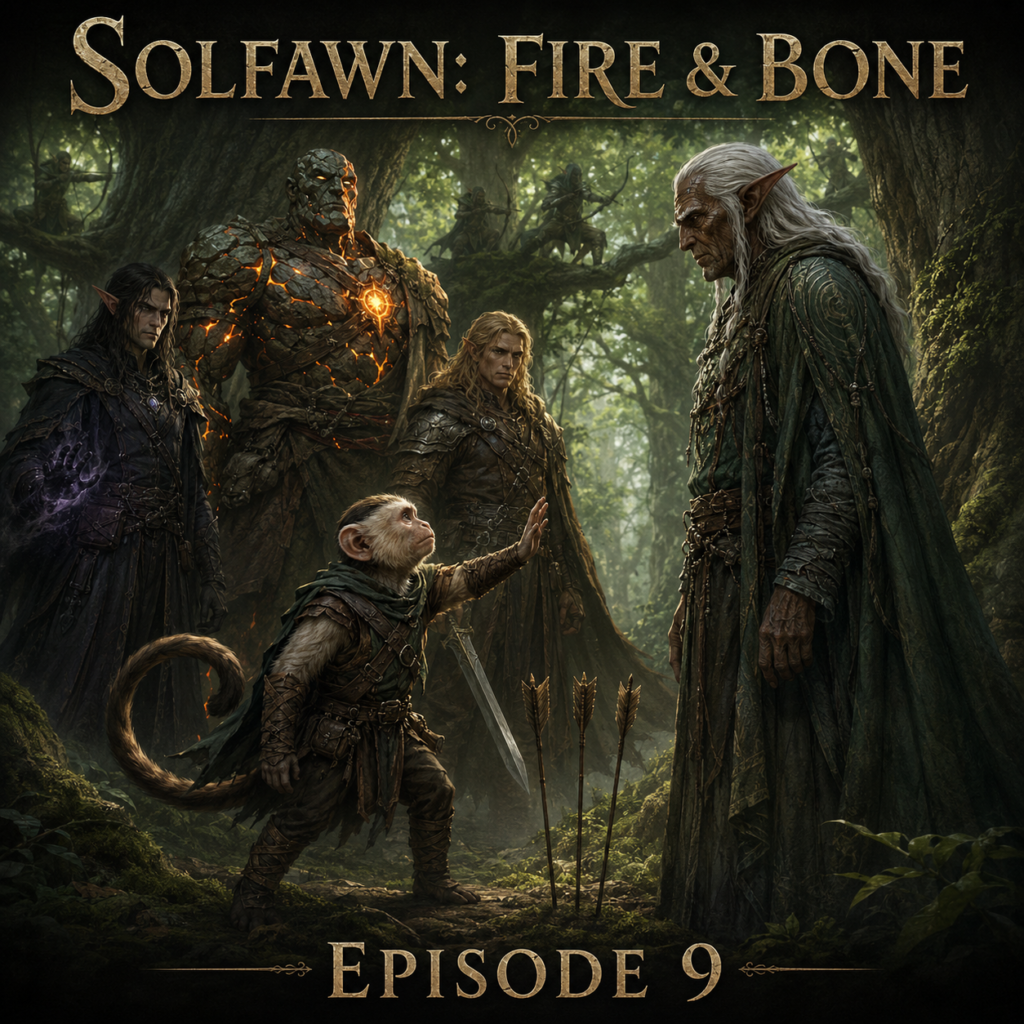
Listen along: Read by Winston Everlast · The Solfawn Deep Dive
Sebastian woke with his face pressed into damp leaves and the conviction that someone had driven an iron spike through the back of his skull.
He opened one eye.
Morning had reached the forest, though it had not reached the ground. Green light filtered through the canopy in thin, reluctant shafts. Every leaf seemed too bright. Every drip of water struck the earth with unnecessary force.
He closed the eye again.
Nearby, Halen groaned.
The sound was low and geological. Birds fled from the branches above him.
“My head hurts,” the Emberkin said.
Sebastian rolled onto his back. The movement caused the forest to tilt.
“I had gathered that.”
“I do not remember drinking.”
“You did not.”
Halen considered this, one stone hand pressed to the side of his head.
“That makes it worse.”
Sebastian sat up slowly. His mouth tasted of copper and mushrooms. The last clear memory he possessed was of the spores bursting around them—pale clouds turning the air thick and sweet, Wyn shouting for them to cover their faces, and Apple disappearing upward into the branches.
After that came fragments.
Halen arguing with a tree.
Sebastian attempting to explain West Haven inheritance law to a fern.
Wyn slapping both of them whenever they tried to lie down.
Apple’s small hands fastening wet cloth across Sebastian’s mouth while calling him something deeply unkind.
Sebastian looked around.
Wyn sat against the trunk of an enormous elm, eyes closed, his bow across his knees. He looked exhausted but otherwise unaffected. Apple crouched on a low branch above him, working burrs from his tail with both hands and a degree of concentration usually reserved for locks.
“You let us sleep on the ground,” Sebastian said.
Wyn opened one eye.
“You were already on the ground.”
“You might have moved us.”
“I considered it.”
“And?”
“You were both very heavy.”
Apple looked down. “Halen tried to carry Sebastian.”
Halen lowered his hand from his head. “That seems responsible.”
“You picked him up by one leg.”
Sebastian looked at him.
Halen looked back.
“I do not remember that.”
“You said you were rescuing him from the roots,” Apple continued.
“They were attempting to steal him.”
Wyn shut his eye again. “The roots were innocent.”
Sebastian rubbed his temples. His hair had come loose during the night and hung across his face in damp golden strands. The headache pulsed behind his eyes in time with his heartbeat.
“How long will this last?”
“I do not know,” Wyn said.
“That answer is becoming less charming.”
“It was never intended to be charming.”
Someone cleared his throat.
The sound came from directly in front of them.
All four of them moved.
Wyn was on his feet before Sebastian had fully turned. Halen rose with more difficulty, one hand briefly touching the wound in his side. Apple vanished from the branch, not downward but upward, disappearing among the leaves. Sebastian found the hilt of his sword and stood despite the sudden hammering inside his skull.
An elf waited on the far side of their camp.
He had not been there a moment before.
Or perhaps he had, and the forest had simply decided they were permitted to see him.
He was old. Not old in the human way, Sebastian thought, though he had never understood precisely how the distinction worked. His skin was brown and weathered like leather left beneath years of sun. Long silver hair fell loose over his shoulders, bright against a robe of layered green and gray. He carried no visible weapon.
He did not need one.
Sebastian saw the first archer when a branch shifted high to the left.
Then another.
Then the curve of a bow above and behind them.
The forest was full of elves.
They occupied the trees without disturbing them. No branch bent beneath their weight. No leaf trembled unless they wished it to. Sebastian counted six before deciding the number was meaningless. For every archer he saw, there were likely several he did not.
Wyn lowered his bow.
Sebastian kept his hand near his sword but did not draw it. Halen let his mace remain on the ground beside his bedroll.
The elder elf’s eyes rested on Wyn.
“Aelwynar.”
Wyn’s expression changed at the use of his full name. The dry amusement vanished from it.
“You know me.”
“I know what you were taught. I know who taught you. That is enough for the moment.”
Wyn glanced toward the archers. “You have an interesting way of greeting a Lore Keeper.”
“You are not here as a Lore Keeper.”
“Then why use the name?”
“Because I would prefer you remember it.”
The elf approached, stopping beyond the reach of Sebastian’s sword. His gaze moved once over the camp, taking in Halen’s glowing seams, Sebastian’s armor, and the empty branch where Apple had been.
He did not look upward.
Sebastian suspected that meant he knew exactly where Apple was.
“I am Gilano,” the elf said. “I sit among the elders of this forest. I have been instructed to tell you that you will lead these outsiders back the way they came.”
Wyn stared at him.
“No.”
The answer was quiet.
Gilano’s expression did not alter. “It was not a request.”
“Then send the other outsiders out first.”
A pause followed.
“Travis and his soldiers,” Wyn said. “You know they are here. You know what they have done. Remove them, and then we may discuss whether my companions are the danger that concerns you.”
“The disposition of the soldiers belongs to the ring of elders.”
“And I do not?”
“My task is to deliver a message to you.”
“That is convenient.”
Gilano’s gaze hardened slightly. “Do not mistake restraint for uncertainty.”
Wyn stepped away from the tree. His face remained composed, but Sebastian had traveled beside him long enough to recognize the signs. Wyn was too still. His voice had lost its theatrical edge. Even his hands hung open at his sides.
Dangerous knowledge interested Wyn.
This was something else.
This was home.
“All elves deserve a choice,” Gilano said. “You have been given yours. Lead the humans and their companions out of Greenvale. If you guide them farther into the forest, your choice will be understood. You will be exiled, Aelwynar. From that moment forward, the forest will offer you no greater welcome than it offers a human.”
Sebastian felt the words land.
Wyn did not move, but something inside him seemed to draw tight.
“You would exile me for walking beside people who are trying to save you?”
“We would recognize the choice you made.”
“Malrick has tricked you.”
One of the archers shifted above them.
Gilano’s face became unreadable. “Take care.”
“He has shown you exactly what he wants you to see.” Wyn’s voice rose. “He has told you this is a human war and offered you a forest without human axes, human roads, or human smoke. But that is not what he is making. He is corrupting living things. He is forcing his will into bodies, roots, animals—anything that will carry it.”
“We have examined the evidence.”
“Then you have examined it badly.”
Sebastian saw Gilano’s jaw tighten.
“Wyn,” Halen warned.
Wyn did not look at him.
“He will make the land inhospitable to humans first,” Wyn continued. “Perhaps that is the part you have decided to call a benefit. But the corruption will not recognize your boundary stones. It will not stop because the trees speak to you. Malrick will change everything that lives here until the forest obeys him—or until nothing can live in it at all.”
“The elders have considered that risk.”
“And?”
“They have decided the risk is worth the benefit.”
For a moment, no one spoke.
Even Apple went still above them.
Sebastian had expected denial. He had expected the elder to call Wyn mistaken, deceived, reckless, or young.
He had not expected agreement.
Wyn’s face showed the same surprise, followed by something much hotter.
“You know?”
“We know enough.”
“And you would permit it?”
“We have watched humans cut roads through living groves. We have watched them burn what they could not own and poison what they could not carry away. We have watched their settlements advance behind soldiers, surveyors, and priests. Do not ask me to tremble because a human weapon might turn first upon those who made it.”
“It is not a human weapon.”
“It is human ambition.”
“Malrick’s ambition is his own.”
Gilano’s mouth tightened. “Do not insult me with the distinction.”
Wyn stepped forward.
Three arrows struck the earth at his feet.
They arrived so nearly together that they made a single sound.
Wyn stopped.
The arrows stood upright between his boots and Gilano, their pale shafts quivering.
Sebastian’s sword had cleared its sheath by the width of two fingers. Halen had one hand on his mace. Somewhere above them came the faint scrape of Apple drawing Quiet Bite.
Gilano looked down at the arrows, then back at Wyn.
“You have been given a choice,” he said. “Do not force others to make it for you.”
He turned.
“Malrick will turn on you.”
Halen’s voice rolled through the clearing.
Gilano stopped.
Halen stood fully upright now. Pain remained visible in the careful set of his body, but it had not diminished him. Morning light caught in the cracks along his chest and shoulders, glowing brighter beneath the dark stone.
“You believe you can use his hatred,” Halen said. “You believe you can stand beside the forge while another people burns and remain unchanged by its heat.”
Gilano faced him.
“I believe elves have survived human wars before.”
“This is not war.”
“No? Your kind carries weapons. Soldiers enter our forest. You pursue one another through our trees. What word would you prefer?”
“Violation.”
Gilano’s eyes narrowed.
“Malrick takes what is living and reshapes it without consent,” Halen said. “He does not heal. He does not guide. He breaks a thing until it serves the purpose he has chosen for it. If you permit him to do that because his first victims are human, then you have not protected the forest. You have taught him what price you will accept.”
“You speak of consent while standing among intruders.”
“We came to stop him.”
“You came because his working threatens your settlements.”
“It threatens life.”
“Human life.”
“All life.”
The heat within Halen brightened.
A bowstring creaked overhead.
Sebastian drew another fraction of his sword. Wyn’s hand moved subtly, shadow gathering at the edges of his fingers.
Gilano raised one hand.
Not toward the archers.
Toward Halen.
“You speak with great certainty for one who knows little of this forest.”
“I know Malrick.”
“You pursue Malrick.”
“I know what he leaves behind.”
“And still you bring weapons deeper into our home.”
“Because you have allowed his weapons to pass.”
The elder’s restraint fractured.
“You know nothing of what we have allowed.”
Halen took one step forward.
The ground beneath his foot gave a faint hiss as dew touched heated stone.
Sebastian drew his sword.
Wyn whispered something that did not settle properly in the air.
Then a small hand appeared between them, waving urgently.
Everyone paused.
Apple hung upside down from the branch above Gilano.
His tail was wrapped around the limb. His fur stood unevenly where the spores and damp had dried into it, and several burrs remained caught near one shoulder. Quiet Bite hung against his back. Both hands were empty.
He waved again.
“I have a question.”
Gilano looked up.
Apple released the branch and dropped. He turned once in the air and landed lightly between the elder and the three arrows.
Sebastian disliked the position immediately.
“Apple,” he said.
Apple ignored him.
Gilano studied the Simiah. “Ask.”
“Why do all the Simiah have to die?”
The question changed the clearing.
Halen’s heat dimmed. Wyn lowered his hand. The archers did not relax, but the tension in their bows became less audible.
Gilano looked at Apple for a long time.
Apple stood with his feet apart and his tail curled behind him. He was small enough that the arrows beside him reached nearly to his shoulder.
“They are not human,” Apple said. “They did not build the roads. They did not send soldiers. They did not make Malrick.”
“No,” Gilano said.
“They live in the forest.”
“Yes.”
“They take care of it.”
“Some do.”
Apple’s ears lowered. “Then why do they have to die?”
Gilano’s gaze moved briefly toward Wyn. “The Simiah at the temple have been warned.”
“Warned about what?”
“To leave.”
“Leave where?”
“That is for them to decide.”
Apple frowned. “You said they live there.”
“They do.”
“Then telling them to leave is telling them to stop living where they live.”
Gilano did not answer.
Apple stepped closer. Sebastian nearly reached for him, then stopped himself. The archers had already shown they could put arrows wherever they wished. A sudden movement would not save Apple.
“I was always told elves were fair,” Apple said.
Something shifted in Gilano’s face.
“Who told you that?”
“My mother. She traded outside our temple. She said elves watched before they spoke and listened before they chose.”
“Your mother was generous.”
“She was careful.”
That, more than anything else, seemed to reach him.
Apple looked up at the elder. “The Simiah are not part of your war with the humans. They are not Malrick. They are not soldiers. If the red thing comes through the forest, they will die too. That is not fair.”
Gilano’s eyes rested on Apple’s hands, then on his tail. His gaze paused at the cord around Apple’s neck, where Koruma’s ring lay hidden beneath his gambeson.
At last, the elder sighed.
It was not surrender. It was the sound of an old certainty discovering an unwelcome edge.
“You will have one chance,” he said.
Apple straightened.
“One chance to convince the Simiah to leave the temple peacefully. You may speak to them. You may tell them what you believe is coming. If they choose to leave, no elf will prevent them.”
“And if they do not?”
Gilano’s face closed again.
“Then they will face the consequences of that choice.”
Apple’s tail drew close to his body.
Sebastian waited for him to argue. Halen seemed to be waiting as well.
Apple looked toward Wyn.
Wyn gave the smallest nod.
“One chance,” Apple said. “I agree.”
Gilano inclined his head.
Then he turned to Wyn.
“I have pondered your words.”
“That was quick.”
“Do not make me regret the effort.”
Wyn said nothing.
“You were trained as a Lore Keeper,” Gilano continued. “That is not insignificant. Whatever else you have become, I will not dismiss your warning without examination.”
Wyn’s expression tightened at whatever else you have become, but he allowed the insult to pass.
Gilano gestured toward the remnants of the red growth scattered beyond their camp. Most had collapsed during the night into wet, fibrous clumps.
“Can you create the red variant?”
“No.”
“Can you reproduce its spores?”
“No.”
“Can you explain the magic that altered it?”
“I can identify parts of the working. Not enough to repeat it.”
“Then what evidence do you possess that Malrick created it?”
“Most of what we found has already been given to the Green Glass Society,” Wyn said. “Records. Samples. Alchemical reports. Notes recovered from his laboratories.”
“Then your evidence is not here.”
“No.”
Apple raised a hand.
Wyn closed his eyes.
“What?” Gilano asked.
“We have the wand.”
Wyn looked at Apple.
Apple looked back.
“The wand under Myra’s bed,” Apple said. “The bad one.”
“I know which wand you mean,” Wyn said.
“Then why did you ask?”
“I did not ask.”
“You looked like you were asking.”
“I was attempting to prevent you from continuing.”
“That is different.”
Gilano waited.
Wyn’s reluctance was visible now. He reached beneath his cloak and removed a wrapped bundle from among his supplies. The cloth around it had been tied carefully, with several small protective marks drawn along the fold. When Wyn opened it, the wand inside seemed to absorb the green morning light.
Gilano did not reach for it.
“This belonged to Malrick?”
“It was concealed beneath Myra’s bed,” Wyn said. “She was his assistant. His handler. Possibly both.”
“Possibly?”
“We do not turn likelihood into fact merely because certainty would be more convenient.”
A faint change came over Gilano’s expression. Approval, perhaps, though it vanished quickly.
Wyn removed several folded pages from another case. Some were copies. Others were originals, stained and creased from travel.
“These refer to the red variant, altered animals, dispersal patterns, and the three ritual points. They are incomplete.”
“Why?”
“Because Malrick did not leave his entire design conveniently arranged for us.”
Gilano held out his hand.
Wyn looked down at the wand.
Sebastian knew what it cost him. Not in coin, though the object might have been valuable. Wyn collected knowledge the way Apple collected gemstones: not from greed alone, but because either might reveal a hidden structure if turned under the proper light. To surrender the wand was to surrender questions he had not yet learned how to ask.
At last, Wyn wrapped it again and placed it in Gilano’s hand. He added the notes.
Gilano accepted them carefully.
“I will bring these before the ring of elders,” he said. “I make no promise beyond that.”
“You will return the wand.”
“If the ring permits it.”
“So no.”
“I said what I said.”
Wyn’s mouth became a thin line.
Halen placed one hand on his shoulder.
“We have done all we can to convince them,” he said. “May the gods be in our favor and let them see the light.”
Gilano looked at Halen’s hand, then at Wyn.
For an instant, Sebastian expected Wyn to shrug it away.
He did not.
Gilano turned from them and raised one arm.
The forest moved.
Sebastian had seen magic tear shadow open. He had watched Halen reshape heated metal with his hands and seen Apple pass through spaces no human body should have been able to cross. None of it prepared him for the quiet obedience of Greenvale.
Branches lifted.
Thorn bushes folded inward. Ferns bent without breaking. Roots sank beneath the soil in slow waves, as though great creatures had rolled beneath the earth. Trees that had stood too close together seemed suddenly farther apart—not uprooted, not shifted, but revealed as though Sebastian had misunderstood their positions until that moment.
A road appeared.
It led deeper into the forest.
The path was wide enough for two of them to walk side by side. No root crossed it. No stone broke the soft brown floor. Even the wet leaves seemed to draw away from its edges.
Gilano stepped off the road and vanished among the trees.
The archers vanished with him.
For several breaths, the party remained where they were.
Apple looked at the three arrows standing in the ground.
“Can I take one?”
“No,” Wyn said.
“You do not know what I was going to do with it.”
“Yes, I do.”
Apple considered this. “That is fair.”
They gathered their camp.
The spore sickness made every task take longer. Sebastian rolled his bedroll twice before realizing he had trapped his own sword belt inside it. Halen attempted to lift one pack and stood staring at it, apparently uncertain why it had become so far away. Wyn moved among them with grim patience, checking straps and distributing water.
Apple climbed onto Sebastian’s back without asking and began working the tangles from his hair.
“I can do that,” Sebastian said.
“You cannot see the back.”
“I have done it before.”
“Yes. Badly.”
Apple divided the long hair into sections, fingers and tail working together. The familiar pull eased something in Sebastian that the morning had tightened.
When they stepped onto the road, the forest received them without welcome.
But it allowed them to pass.
* * * The road continued throughout the day.
It did not wander. It did not narrow. When fallen leaves collected across it, they lay flat beneath the party’s feet. When rain began briefly in the afternoon, the branches bent over the path and caught most of it.
No animals approached.
That troubled Sebastian more than an attack might have.
Wyn walked ahead for much of the day, speaking to no one. Halen remained beside him despite the slower pace forced by his wound. Neither acknowledged the arrangement.
Apple moved between them all, sometimes scouting ahead, sometimes returning to inspect the path behind. He climbed no farther than the lowest branches.
The archers were gone.
Sebastian did not believe they were unobserved.
Near evening, the road ended in a clearing.
Not gradually. One moment the path stretched ahead beneath the trees. The next it opened into a circle of grass large enough for their camp. At its center lay a ring of stones around a bed of dry kindling. Four places beneath the trees were clear enough for bedrolls.
Beyond the clearing, the forest became impassable again.
Apple walked to the wall of green and pressed both hands against a screen of woven branches.
“It stopped.”
“For the night,” Wyn said.
“How do you know?”
“The fire.”
Halen approached the stone ring. “They want us to remain here.”
Sebastian looked at the darkening trees. “I dislike being instructed by a road.”
“You prefer being instructed by noblemen,” Wyn said.
“No. I am merely more practiced at disappointing them.”
That earned the smallest movement at the corner of Wyn’s mouth.
Halen knelt beside the fire ring and touched one finger to the kindling. A soft orange glow passed from the crack in his hand into the wood. Flame rose without smoke.
They ate what remained of the food they could carry easily. Wyn tested the water. Halen inspected Apple’s healing cuts, then allowed Sebastian to inspect the stone around his own wound. It had sealed, but the glow beneath it remained uneven.
No one mentioned the possibility of elves watching from the trees.
Mentioning it would not make them less watched.
When the meal was finished, Apple sat near the fire with his knees drawn up.
Sebastian settled across from him.
“What do you think it will be like?”
Apple looked at him. “What?”
“The monastery. Seeing another Simiah temple.”
Apple’s gaze moved toward the trees.
“It may not be like mine.”
“I know.”
“No, you know the words.” Apple picked at a frayed edge on his gambeson. “Ru Temple was in the jungle. We built in the crownwood. We had lifts and bridges and the Heart Stone. The females traded. The males worked the wards and stone and metal.” He paused. “That does not mean every temple does those things.”
Wyn sat near the fire, cleaning dirt from beneath one fingernail with the tip of a small knife.
“Cultures often mistake local custom for universal law,” he said.
Apple frowned at him. “I just said that.”
“You said it more efficiently.”
Apple accepted this.
Sebastian leaned forward. “Do you think they will welcome you?”
“No.”
The answer came too quickly.
“Why not?”
“Because I am not from there.”
“You are Simiah.”
Apple gave him a level look. “You are human. Does every human welcome you?”
Sebastian thought of West Haven, Stonegate, St. Germain, and the bounty his family had placed upon him.
“Point taken.”
“They may know Ru Temple,” Apple said. “They may know my father’s ring. They may know nothing. They may think I am too human now.”
“You are not human,” Halen said.
Apple’s nose wrinkled. “I know.”
“I did not mean it as an insult.”
“I know that too.”
Halen inclined his head.
Apple touched the cord beneath his gambeson. “If they know Ru Temple, they may know what happened. Or they may have heard a wrong story. Sometimes wrong stories travel farther because they are easier to carry.”
The fire cracked.
Sebastian watched Apple’s hand remain over Koruma’s ring.
“And if they ask you to stay?” he said.
Apple’s fingers went still.
No one else moved.
At last, Apple looked around the fire—at Wyn with his dark hair and careful hands, at Halen with banked light moving through his stone, at Sebastian with the braid Apple himself had made.
“I will decide when they ask.”
It was not an answer.
It was the only answer he owed them.
Halen looked toward the path behind them. “I am glad to be out of the forest.”
Wyn glanced at the trees surrounding the clearing.
“We are in the forest.”
“We are out of the part that was attempting to poison us.”
“The night is young.”
Halen looked at him.
Wyn sighed. “That was a joke.”
“It was not a good one.”
“No,” Wyn said. “I am grieving.”
His gaze dropped to the empty place beside his pack where the wand had been.
“You believe Gilano will keep it,” Sebastian said.
“I believe the ring of elders will study it for as long as they please, decide they understand it better than I do, and place it in some protected hollow where no one will touch it for a century.”
“That sounds safe.”
“It sounds useless.”
“You gave it willingly.”
“I surrendered it under observation by enough archers to make the distinction philosophical.”
Halen stirred the fire with a branch. “You did what was necessary.”
“Yes. People say that when they want you to feel better about losing something.”
“Do you?”
“No.”
“Then I will not say it again.”
Wyn looked at him.
“Thank you.”
Halen nodded.
His hand moved to the ring he wore.
The gesture was almost unconscious. He turned the band once, then pressed his thumb against it. The glow within his wrist sharpened briefly. A faint warmth moved through the metal, steady and answering.
Halen closed his eyes.
The tension went out of his shoulders.
“The egg is safe,” he said.
Apple watched him.
“Do you regret not going with it?”
Halen opened his eyes.
“No.”
The answer carried no hesitation, though sorrow lived inside it.
“The egg is protected. Others can carry it where it needs to go. I am needed here.”
“You wanted to go.”
“Yes.”
“You still do.”
“Yes.”
Apple waited.
Halen looked toward the dark trees beyond the fire. “Wanting two things does not make one of them false. The egg is part of my people’s future. Malrick threatens the future of everyone on Solfawn. I cannot protect one by abandoning the other.”
He touched the ring again.
“The egg is safe. Now I must help make Solfawn safe.”
Apple seemed satisfied.
Sebastian was not listening anymore.
The ring had reminded him of another.
He felt its weight inside his pocket.
It had been there since the chest.
Through the spores, the argument, the arrows, and the long road, he had remained aware of it. Not constantly. Not enough to draw attention. But the mind returned to certain objects the way a tongue returned to a broken tooth.
He reached into his pocket.
The others noticed.
Apple first.
Sebastian opened his hand.
Firelight moved across thick gold and vanished into flawless black onyx.
Wyn’s attention sharpened.
“That came from the chest,” he said.
“Yes.”
“You said there was nothing else inside.”
“I said there was nothing else useful.”
Apple leaned forward. “Gold is useful.”
Sebastian turned the ring between his fingers.
“There is an engraving.”
He had not intended to tell them tonight. He had not intended to tell them until he understood what it meant.
But the forest had spent the day forcing choices upon them, and secrecy felt suddenly too much like another road made by someone else.
He held the ring toward the fire.
Inside the band, the letters remained clean and sharp despite the centuries that had passed around them.
Senca Valcour.
Apple moved closer.
“Valcour.”
Sebastian nodded.
Wyn held out his hand. Sebastian hesitated, then passed him the ring.
The elf examined the gold, the onyx, and the engraving.
“The chest was sealed before the eruption,” Wyn said.
“Yes.”
“And buried when Glarus fell.”
“Yes.”
Halen watched Sebastian. “Then your House was here.”
“Someone bearing its name was.”
Wyn looked up. “That is not necessarily the same thing.”
“No. But it is not nothing.”
Sebastian took the ring back.
The onyx was warm from Wyn’s fingers. He closed his hand around it, just as he had when he first read the name.
“My father spoke of our family as though it began with him,” Sebastian said. “Not literally. There were portraits, records, names recited at ceremonies. But the history he valued was the history that justified what he already possessed. West Haven. St. Germain. The House. Its authority.”
He opened his hand again.
“This was in Glarus before the mountain destroyed it. Before House Valcour ruled West Haven. Perhaps before West Haven was anything worth ruling.”
The fire reflected on the gold.
“If Senca Valcour had some connection to the Forge Eternal, then my family’s ambition is older than I knew. Whatever they attempted here—whatever caused the breach, or failed to contain it—my blood may have been part of it.”
“May have been,” Wyn said.
Sebastian nodded. “May have been.”
He appreciated the correction. He hated it too.
“My father believes power is proof of worth. Julien believes anything that can be taken should belong to the person clever enough to take it. I have spent years telling myself those beliefs were theirs.”
“Not yours,” Apple said.
“I carry them.”
“That is not the same.”
“No. But sometimes the difference feels smaller than I would like.”
Halen’s fire had gone quiet. Even the forest seemed to be listening.
Sebastian looked down at the name.
“The terrible thing is that I am proud.”
No one answered immediately.
“I found evidence that my family may have helped destroy one of the greatest cities that ever stood on Solfawn, and some part of me is proud that we were there. That our name was old. That it mattered.”
He laughed once, without humor.
“I do not know Senca. I do not know whether Senca was a ruler, a servant, a scholar, or a thief who stole this from someone else. I do not know whether the Valcours tried to stop the Forge Eternal or helped open it. But when I saw the name, I felt—”
He searched for the word.
“Continued.”
Wyn studied him across the fire.
Sebastian turned the ring slowly.
“You asked once why humans care so much about Houses,” he said.
“I believe I called them inherited cages.”
“You did.”
“I remain pleased with the phrase.”
“For you, the past is a place you have visited.”
Wyn’s expression changed.
“You remember teachers who remembered their teachers. You can speak of events a human would receive as fragments copied from fragments. Your life reaches backward in a way mine cannot.”
“Not as far as you imagine.”
“Farther than mine.”
Wyn did not dispute it.
“A human life passes quickly,” Sebastian said. “We watch buildings outlast the people who raised them. We inherit swords from hands we never touched. We give children the names of the dead because otherwise the name ends.”
His thumb traced the edge of the onyx.
“We cannot continue alone. So we make chains. Parent to child. Teacher to student. House to heir. We tell ourselves the chain means we were not merely here and gone.”
Apple touched Koruma’s ring beneath his clothing.
Sebastian noticed.
“Sometimes the chain is love,” Sebastian said. “Sometimes duty. Sometimes vanity. Often all three.”
“And sometimes a cage,” Wyn said.
“Yes.”
The agreement sat between them without anger.
Sebastian closed his hand around the ring.
“I have spent so long trying to escape House Valcour that I never considered how it would feel to find it waiting beneath a dead city. I am afraid my family is trying to repeat something it began here. I am afraid our modern ambition is only an old disaster learning new names.”
He looked at the ring in Halen’s hand, then at the one in his own.
“And I am proud that the chain did not break.”
Halen regarded him for a long moment.
“The egg is a secret to my past,” he said at last. “I never carried one. I never completed the rite. Yet when I felt it, I knew it belonged to something before me and something after.”
His gaze lowered to the gold ring bearing the Valcour name.
“That ring is the same for you.”
Sebastian frowned. “The same?”
“Not in what it is. In what it asks.”
The fire shifted, sending sparks upward.
“The egg is the secret to both of our pasts,” Halen said. “Mine because it carries the life my people protected before I was born. Yours because your people may have stood beside that life before the mountain fell.”
Sebastian looked at him.
“What if my ancestors tried to use it?”
“Then learn from them.”
“What if they caused the breach?”
“Then do not repeat them.”
“What if the ambition is part of me?”
Halen’s ember-lit eyes held his.
“Then shape it into something better.”
Beyond the clearing, the forest moved.
Branches creaked. Leaves whispered. Somewhere in the darkness, something large passed between the trees without approaching the fire.
Sebastian slid the ring onto one finger.
It fit.
He stared at it for a moment, then removed it and returned it to his pocket.
Not yet.
Perhaps never.
But he would no longer hide its existence.
The four of them sat together until the fire burned low. Above them, the canopy concealed the stars. Ahead, the forest kept its road hidden for the night.
In the morning, it would decide whether to let them continue.
And somewhere beyond the trees, the Elder Tree Monastery waited.