Fire & Bone — Chapter I
· Winston Everlast
Listen along: Read by Winston Everlast · The Solfawn Deep Dive
The wagons burned behind them. At first the fire had taken reluctantly, licking at the splintered boards as though even flame disliked what had been left there. The wood was old, damp in places from leaked casks and blood, and the black substance clinging to the underside of one broken axle hissed when Halen set the torch to it. For several breaths it seemed the whole ruin might only smoke.
Then something inside one wagon caught. The fire climbed. It ran along the cracked ribs of the frame, found the oil-soaked canvas, and opened upward in a sudden orange sheet. Heat pushed across the road. Smoke rolled black and greasy into the red evening air.
Apple watched from a safe distance with his tail curled tightly around one leg.
He had seen too many fires. Temple fire. Campfire. Pyre fire. The Wall’s watch flames burning cold in the night while things with wet hands climbed out of the sea below.
This fire was none of those, and also all of them. It ate the wagons slowly, with wet pops and cracks from the warped wood. It found the dead next. That smell came after the smoke, after the tar, after the sharp mineral stink of broken ashglass. Meat. Hair. Cloth. Old fear made warm again.
Apple’s nose wrinkled. He turned his face away. “Don’t breathe too deeply,” Wyn said beside him. Apple gave him a look. Wyn’s dark hair was tied back poorly, as usual, strands of it escaping around his long ears and catching the firelight. He had wrapped a cloth loosely over his mouth and nose, which did very little except make him look as if he had prepared for the situation more elegantly than anyone else.
“That advice would have helped before the smell happened,” Apple said.
“Yes, well.” Wyn looked back at the burning wagons. “I do my best thinking after the obvious has already occurred.”
Halen stood closest to the fire. Too close, Apple thought, though perhaps heat meant something different to an Emberkin. The firelight moved over the dark stone of Halen’s skin, turning the cracks in him briefly brighter, the glow beneath showing through like banked coals disturbed by breath. He held the spent torch in one hand and watched the wagons burn with an expression that was not satisfaction.
It was judgment. Sebastian came up from the far side of the road carrying the map case. The case was blackened along one side but intact, stiff leather reinforced with brass at the corners. A wax seal had partly softened in the heat before they found it. The impression remained visible enough.
A house insignia. St. Germain. Or something close to it. Sebastian turned it in his hands. “I’ve seen this before.” Wyn’s eyes moved to him. “That is rarely the beginning of a pleasant sentence.” “I didn’t say I knew it.” “No. You said the more troubling version.” Sebastian frowned at the seal. “It’s a St. Germain house. Minor, maybe. Or old. I can’t place it.” Halen turned from the fire. “Open it.” Sebastian looked at him. “Halen.” “Open it.” “There may be a proper way to do that.” “There was a proper way to transport whatever was in those wagons,”
Halen said. “That way appears to have failed.” Sebastian slid a knife beneath the softened wax and broke the seal. No one spoke while he opened the case. Inside was a rolled map, bound with a narrow red cord. Sebastian removed it and crouched on a flat stone beside the road, weighing the corners down with bits of broken basalt so the wind would not take it.
The map showed the region north of Glarus in a careful hand. Not a merchant’s broad road map. Not a soldier’s campaign sketch either. This the margins like thoughts written quickly before they escaped.
Wyn tapped one mark. “That is where we are.” Apple looked from the map to the road, then back again. “You know that?” “I possess many gifts.” “You guessed.” “I guessed accurately.” Sebastian pointed farther north. “The trail bends toward Fishbrook.” Halen’s gaze stayed fixed on the map. “And before Fishbrook?” Wyn followed the line. “There. A marked camp. No name. Just a symbol.” Apple glanced toward the burning wagons. “More wagons?” “Possibly.” “More dead people?” “Also possible.” “More horrible black sludge?” Wyn tilted his head. “At this point, I would be disappointed by its absence.” Apple looked at him. Wyn sighed. “Not morally disappointed.” Near the fire, something burst. A section of wagon wall collapsed inward, sending sparks up in a twisting column. Beneath it, the black sludge bubbled briefly and then burned with a low greenish edge before vanishing into the larger flame.
Halen watched it burn. “Good,” he said. Sebastian looked up from the map. “We might have needed a sample.” “We have seen enough of it.” “That isn’t the same thing.” “It is enough for me.” Sebastian stood. “We don’t know what it does.” “We know what it was near.” “The bodies were near it. The horn was near it. The grain was near it.
That doesn’t tell us whether it caused anything, preserved anything, attracted anything, or kept something away.”
Halen’s eyes brightened. “It was corruption.” Sebastian did not step back. “Maybe.” “Not maybe.” Apple’s tail tightened around his leg. Wyn finally looked up. “Halen, Sebastian is not suggesting we keep a jar of evil for sentimental reasons.” “I am suggesting,” Sebastian said, “that burning every piece of evidence may become a problem.” Halen looked at him. “And I am suggesting that letting Malrick’s work remain in the world is already a problem.” The name settled over them. Malrick. Even the fire seemed to dim around it, though of course it did not.
Names did that sometimes. Apple had noticed. Some names were not sounds. They were doors.
Apple looked down at the map again. He pointed to the word beside the northern mark.
“That says Fishbrook?” Wyn’s argument-face vanished at once. He leaned closer. “Yes.” Apple studied it. Fishbrook. He knew the first sound now. The hooked mark. The shape that began like breath through teeth. “Fish,” Apple said, testing the word against the letters. Wyn smiled slightly. “Very good.” Halen and Sebastian both stopped arguing. Apple felt them notice and immediately regretted speaking. He pulled his hand back from the map and glared at the road as if the dirt had offended him.
“What?” “Nothing,” Sebastian said. That was worse than something. Halen turned back to the fire. “We leave when the burn settles.” Sebastian rolled the map carefully. “We should move before dark.” “We move after I know this cannot spread.” Wyn stood, brushing dust from his knees. “Both of those positions have merit. Naturally, this means neither of you will enjoy hearing the “I still think we may regret it.” “Likely.” Sebastian blinked. “Likely?” Halen turned then. “Most choices are regretted by someone. That does not make all choices equal.” The fire settled lower. What had been wagons became shapes. What had been bodies became less than that. The black sludge was gone, or gone enough that no one could see it beneath ash and ember. Smoke continued to rise in thick coils, then broke apart in the wind and dragged itself northward over the trail.
Halen stood there until the last greenish flare had vanished. Only then did he turn away. “We go.” No one argued this time. They gathered their packs. Sebastian carried the map case. Wyn adjusted the strap of his satchel, muttering under his breath about smoke in his hair. Apple checked his foot wrappings and then checked them again. The basalt here was sharp in ways that seemed personal. He had already learned that the ground north of Glarus liked to bite.
They started north. For a while, no one spoke. The burning wagons fell behind them step by step, but the smell followed longer than Apple wanted. Smoke. Fat. Tar. Mineral rot. Fire trying to make the world clean and not quite succeeding.
He glanced back once. The flames had lowered to a red pulse in the darkening road. Beyond them, the ruined wagons glowed like the ribs of some dead beast opened to the air.
For one strange moment, Apple thought of the Heart Stone hidden high in the Ru Temple jungle, packed away in the hollow where he had left it. Another secret left behind. Another dangerous thing waiting in a place no one else understood.
He faced forward again. Ahead, the road bent toward Fishbrook. Above it, the first stars appeared through the dust.
⁂
The dust came before the wind. Apple noticed it first as a change in the ground’s voice. The basalt crust underfoot had been crackling softly with every step, brittle flakes snapping beneath their boots and paws, but gradually another sound joined it–a dry whispering that moved across the flats ahead of them.
He stopped walking. Sebastian nearly bumped into him. “What is it?” Apple crouched and touched two fingers to the ground. Fine black grit trembled in the cracks. “Something’s moving.” Halen looked north. Wyn turned slowly, his dark hair pulling loose in the strengthening air. The horizon had begun to disappear. Not all at once. It faded by degrees, as if someone had drawn a charcoal thumb across the line where land met sky. The far ridges blurred. Then the nearer ones. Between them and the darkening trail, a low wall of dust rose and folded over itself.
Sebastian shaded his eyes. “Storm?” “Obsidian dust,” Halen said. That made Wyn lower the cloth from his mouth. “How far?” Halen watched the advancing haze. “Soon.” Apple did not like the sound of that. Storms in the jungle had announced themselves through layers. The insects changed their song. Leaves turned their undersides to the sky. Birds flew low. The air thickened, and then rain came, hard and warm and honest. Even if a storm was dangerous, it belonged to the world Apple understood.
This did not. The dust moved like something with purpose. The wind rose behind it. A long black ribbon of grit lifted off the road and struck Apple across the face. He flinched, turning away as the particles bit at his eyes and nose. The grit was finer than sand and sharper than ash. It caught in his fur immediately. He spat and tasted mineral bitterness on his tongue.
“We need cover,” Sebastian said. stake. Wind slammed across the flats with enough force to make Apple drop to all fours. The world vanished into black motion. Dust struck from every side at once, not falling but driving, sliding through gaps in clothing, biting exposed skin, filling breath and thought.
Sebastian was fighting with the tent canvas, one arm wrapped around a pole while the wind tried to peel the whole thing out of his grip. Wyn had both hands on the other side, swearing in Elvish with enough precision that Apple understood none of the words and all of the meaning.
Halen drove a stake into the ground with the blunt head of his mace. The stake split. He looked at it for one silent second, then picked up a larger shard of basalt and hammered the broken pieces into the ground anyway. “Useful terrain,” Wyn shouted over the wind. “Very cooperative.” “Less commentary,” Halen said. “I am contributing to morale.” “You are not.” Apple crawled toward the loose edge of the canvas and threw his weight onto it before the wind could take it. The fabric snapped beneath him like something alive. His tail lashed out and wrapped around a peg line while both hands fought to pull the canvas lower.
Sebastian looked over at him through the dust. “Hold there!” “I am holding!” “Hold more!” Apple bared his teeth. “I am going to bite you when this is done!” “That means he’s fine,” Wyn called. Between the four of them, the tent became less a shelter than an argument they were temporarily winning. By the time they had camp arranged, everything was black. Not night. Not fully. Something worse. The storm swallowed the last light and gave nothing back. Their lanterns showed only the inside of the dust, a churning skin of particles moving inches from their faces. The fire would not take. The bedrolls tasted of stone. Water had to be poured carefully and covered immediately or it became grit.
Apple crouched near the tent entrance and shook his head violently. A cloud of dust came out of his fur. Sebastian, sitting opposite him, looked down at his own sleeves and grimaced. “I think I have half the Blacklands in my shirt.” Wyn leaned back against a pack and began picking grit from his hair with an air of deep personal betrayal. “Only half? You must have been standing behind me.”
Apple watched the entrance flap shudder under the wind. “Can things move in this?” “Yes,” Halen said. Apple looked at him. “That was not the answer I wanted.” “It is the answer.” Sebastian leaned forward, elbows on knees. “We’ll keep watch in pairs.” Halen nodded once. “Short watches. Visibility will be poor.” “Poor,” Wyn said, “is generous. I cannot see my own knees.” Apple glanced down. “They’re still there.” “Thank you.” “You’re welcome.” For a while, no one spoke. The storm filled the silence. Apple tried to listen beneath it. That was what unsettled him most.
The wind made the world too loud to read. In the jungle, sound came layered and directional. Here, everything was everywhere. The storm erased distance. It erased direction. It made the world small and blind and full of teeth.
He did not realize he had drawn one of his talon blades until Wyn looked at his hand.
“Planning to stab the weather?” Apple looked down at the blade. “Maybe.” “A bold strategy.” “I do not like it.” “The weather?” “The not knowing.” Wyn’s expression shifted slightly. Not into pity. Instead the elf reached into his satchel and drew out the rolled map from the case Sebastian had carried. He did not open it fully. There was not enough room, and the air inside the tent would have filled it with dust anyway. Instead he loosened only the top edge and turned it toward Apple.
Wyn pointed to the word. “Fish. Brook. Two pieces. Together, one place.” Apple studied the marks. The letters were still strange, but less strange than before. He recognized the first part. Fish. The hooked beginning. The narrow middle. The ending that closed like teeth.
“Fish,” he said. “Good.” Wyn moved his finger. “Brook.” Apple’s mouth tightened. “Too many bends.” “It has fewer bends than Aelwynar.” “That is why Wyn is better.” Sebastian made a quiet sound. Wyn gave Apple a dry look. “You wound me.” “No.” “A little.” “No.” “Continue.” “Buh,” Wyn said. “Ruh. Oo. Kuh.” Apple stared at the letters as if they had personally arranged themselves to irritate him. “Brook,” he said at last. “Again.” “Brook.” “Together.” Apple inhaled. “Fishbrook.” “Good.” Halen lifted one hand sharply. Everyone went still. Apple’s blade was back in his hand before he had thought to reach for it. Sebastian shifted toward his sword. Wyn’s finger remained on the map, but his eyes moved to the entrance.
“What?” Sebastian whispered. Halen listened. Then Apple heard it too. Not close. Not loud. A sound beneath the wind. A deep, broken bellow. Apple’s ears flattened. “Cattle,” Wyn said. No one moved. The sound came again. A low animal call, stretched thin by distance and dust, wrong in some way Apple could not immediately name. He had heard cattle before. They were large, dull-smelling creatures with wet noses, patient eyes, and the general air of beings surprised by their own existence. This sound had the shape of cattle, but something inside it had been bent.
Halen rose. Sebastian caught his arm. “You can’t see anything out there.” “I can see more than you.” “That’s not the same as enough.” Halen pulled the tent flap aside. Wind and dust burst inward. Everyone turned away except Halen. He stepped out into the storm and vanished almost immediately into black motion. “Halen!” Sebastian snapped. For several moments, there was only the open flap, the storm beyond it, and Halen’s absence. Then the ember-glow of him appeared again, blurred and distorted by dust. He ducked back into the tent and pulled the flap shut behind him. Black grit ran off his shoulders.
“West,” he said. “Movement.” “How much?” Wyn asked. “A herd.” Apple felt his stomach drop. “Normal herd?” Halen looked at him. That was answer enough. “They are far,” Halen said. “Moving north. Not toward us.” Another bellow rolled through the storm. This one carried longer.
Apple felt it in his teeth. Wyn slowly began rolling the map closed. “I dislike how often things here are technically not coming for us until they are.” No one argued. They sat in the dim lantern-light while the storm battered the tent Many of them. Outside, beyond the storm, something huge moved through the night.
⁂
The first hoof struck the ground like a hammer on stone. Apple felt it before he understood it. A dull impact traveled through the basalt beneath the tent, up through his hands, into his teeth. Then came another. Another. Not the scattered, uneven movement of frightened animals passing at a distance, but a gathering rhythm.
Heavy bodies. Many of them. The canvas shivered. Not from wind this time. Apple could smell them now. Cattle, yes. Hide. Hoof. Old grass fermented in the gut. But under that came something else, something wrong and bright. Burned hair. Hot iron. Cracked stone after lightning. A mineral heat that did not belong in a living body.
Halen pulled the flap aside. This time the storm outside was not empty. Shapes moved in it. At first they were only darker densities inside darkness. Then one came near enough for Apple to see the glow. Fire lived under its hide. Not flame exactly. Veins of red-orange light moved beneath blackened skin, pulsing through the huge body like molten rivers trapped under a crust. Its horns were jagged and dark, one split along the curve with red cracks running through it. Smoke leaked from its nostrils. Each breath came out as a furnace gust that briefly cleared the dust before the storm swallowed it again.
It was too large. Not just large like a bull. Larger. Heavy through the shoulders, low and broad, with a head that looked built to break gates. Behind it moved smaller forms, though smaller only in relation to the monster leading them. The young ones were the size of full-grown cattle, their legs thick, their backs smoking, their eyes lit dull red through the dust.
Halen let the tent flap fall. “They are moving across us.” Sebastian was already reaching for his sword. “Across the camp?” “Yes.” The answer came not in words but in impact. The herd hit the edge of camp. A stake tore loose. One of the outer lines snapped, and the entire tent lurched sideways. Something huge slammed into the second tent outside. Canvas screamed. A pole broke. The ground shook beneath a rush of hooves.
“Out,” Halen said. There was no time to do it neatly. Sebastian kicked through the half-loosened flap and rolled into the storm with his sword still coming free. Wyn followed low, cloak wrapped tight around his face. Apple seized the map case on instinct and shoved it under one arm before springing out after them.
The world outside had become red-black motion. Dust filled everything. Hooves hammered around them. The ruined second tent whipped and twisted under the feet of the herd until it vanished beneath trampling bodies. One young ox crashed through the cook gear. Another struck a pack with one hoof and burst it open, sending cloth, rope, and dried food skittering across the basalt.
The largest bull moved through the storm like a burning hill. Apple dropped the map case behind a low rock and climbed without thinking. Hands, feet, tail. Up onto the basalt shelf. Higher. The stone bit through his wrappings, but he ignored it.
From above he saw the shape of the danger. The herd was not attacking them. It was worse than that. It was panicking. The animals circled and collided with one another, huge bodies changing direction too quickly, each movement forcing another reaction. Heat shimmered around them. Their glowing veins flashed in and out of the dust like buried lava.
Sebastian pulled Halen aside just before one of the young oxen thundered between them.
“Not the legs,” Halen said.
The young beast lowered its head and charged. Wyn raised one hand and spoke a word that made the dust between them seem to hesitate. For a heartbeat, shadow gathered under the ox’s feet. The beast stumbled as if the ground had remembered it was supposed to hold things down.
“Apple!” Wyn shouted. Apple was already moving. He leapt from the basalt shelf onto the sagging remains of the second tent, used the snapping canvas like a branch under tension, and sprang from it toward the ox’s back. Heat struck him before he landed. Too hot. His fur prickled. The remaining heat lotion on his skin fought the worst of it, but pain still flashed along his arms.
He landed low between the creature’s shoulders and drove a talon blade down into a glowing seam where the hide had split.
The creature screamed. Not low like cattle. High. Almost human in its agony. Apple froze for the smallest fraction of a second. The beast threw him. He twisted in the air, hit the ground hard on one shoulder, rolled under a wash of heat and dust, and came up on all fours just as a hoof came down where his head had been.
Sebastian struck then. Not at the legs. At the side of the neck, where Apple’s blade had opened the seam. The broadsword bit deep. Light flared under the wound. Blood came out black and steaming, threaded with red crystals that shattered when they hit the ground.
Halen’s mace struck the skull from the other side. The creature collapsed sideways, missing Sebastian by less than a pace and shaking the ground hard enough to send Apple back to one knee.
One down. Too many left. The largest bull bellowed again. This time it saw them. “Move!” Sebastian shouted. The bull charged. Halen stood his ground. Of course he did. The charge hit. Halen met the bull with his shield and mace braced low. For a heartbeat, absurdly, it looked as though he might hold. Stone against burning flesh. The impact cracked across the camp. Halen slid backward, boots tearing grooves through grit and loose basalt.
Then the bull’s head twisted. One jagged horn caught him under the ribs and lifted. “Halen!” Sebastian shouted. Halen struck downward with the mace as he was thrown, catching the horn near its base. A crack of red light split through it. The bull roared and tossed him aside. Halen hit the ground hard, rolled once, and came up slower than he should have.
That frightened Apple more than the blood. A smaller ox cut between Halen and Sebastian. Apple felt something cold and precise open in his chest. The storm vanished from importance. The hooves. The heat. The noise. All of it became position. Sebastian there. Halen injured. Wyn too far left. Young ox in the gap. Large bull turning. Apple stepped backward into shadow. There should not have been enough shadow. But Apple had been practicing, and fear had a way of making lessons honest. He reached for the thin dark under the collapsed tent, the black line behind a basalt edge, the place where the lantern light failed inside dust.
The world folded. Only for a breath. Cold brushed over him, not like night but like the underside of a closed eye. Then he was behind the young ox. Apple struck both blades into the back of its hind leg where the tendon should be. It screamed and buckled. become. Apple had no time to decide. The big bull charged again. Wyn stepped into its path. That made even Halen shout. “Wyn!” The elf did not move away. His dark hair whipped around his face in the wind. He lifted both hands and spoke into the storm. This time the words were not sly or amused. They were hard and old, shaped with enough force that the dust around him blew outward in a sudden ring.
The bull’s glowing veins flared. Then dimmed. Not fully. But enough. The creature stumbled as if some inner strength had been cut. Vulnerable. Sebastian ran in from the right. Halen from the left. Apple from below. The bull swung its broken horn toward Sebastian. Sebastian ducked too late. The jagged tip caught his shoulder and tore through leather and flesh, spinning him backward. He hit the ground and slid.
Apple screamed his name without meaning to. The bull stepped toward him. Halen struck the wounded horn with both hands on the mace. The cracked base shattered. The horn broke free in a burst of red-black fragments and steaming blood. Apple darted under the massive neck and drove one blade up into the soft place beneath the jaw. Heat burned through the hilt. Pain flashed through his fingers. He held on anyway and dragged the blade sideways with all his weight.
The bull roared. Sebastian rose from the ground with blood running down his arm and drove his sword into the open wound Apple had made. Halen struck the skull again. Wyn spoke one final word. The bull’s legs gave. “Back!” Halen shouted. Apple tried. The bull fell. For a terrible instant, the whole world became weight. Apple saw the enormous shoulder rolling toward him, too close, too fast. He sprang backward, but his foot slipped on loose basalt. The ground broke under his heel. Pain shot up his leg.
The bull came down. Sebastian’s hand caught the back of Apple’s harness and yanked. Apple flew backward hard enough to hit Sebastian’s chest and knock them both to the ground. The bull crashed down where Apple had been, its burning side slamming into the stone with enough force to crack the basalt shelf beneath it.
Heat rolled over them. Apple coughed and twisted free. “Don’t pull me like that,” he snapped. Sebastian stared at him. Blood ran down his sleeve. “You’re welcome.” “I was moving.” “You were about to be paste.” “I was moving quickly.” “You were moving under a dead bull.” Halen stepped over them, breathing heavily. “Argue later.” The remaining young oxen were retreating, swallowed by dust until only dull red pulses remained. The storm continued. Of course it did. They salvaged what they could in the aftermath. One tent could still be made to stand if no one breathed too hard near it. The second was useless. Two bedrolls had survived. One had hoof prints across it but no holes. The map case had remained where Apple shoved it, protected by the low rock, though the leather was now coated black.
Inside the fallen bull’s torn hide, Apple found the first stone. An amethyst. Not set. Not polished. Grown inside the flesh. Wyn looked over. “That is unpleasant.” Apple stared at the stone in his palm. “It’s pretty.” “Those are not mutually exclusive.” They searched the bodies because no one wanted to, and because not wanting to was not a sufficient reason to avoid learning what Malrick’s Sebastian looked at them with disgust. “Gems from cattle.” “Modified cattle,” Wyn said. “That is not better.” “No. But it is more accurate.” Halen stood over the stones. “They were made to carry something.” Wyn nodded slowly. “Or grow something.” “Or feed something,” Sebastian said. Apple did not like any of those. Apple took the last watch with Wyn. The storm had faded to a cold wind by then, carrying loose dust across the ground in low streams. Around the camp, the dead oxen had stopped glowing except in a few deep wounds where red light pulsed faintly, slowly, like something not yet willing to admit it had died.
For a long time, they said nothing. Then Wyn spoke. “I asked the veil.” Apple looked at him. “About what?” “The black sludge.” Apple’s ears lifted. “It would have kept them away,” Wyn said. Apple understood at once. “The stuff Halen burned.” “Yes.” “Are you telling him?” “Not tonight.” “Because he’s hurt?” “Because he already knows enough to punish himself without assistance.” Apple considered that. “He thought he was making it safe,” Apple said. “Yes.” “He was wrong.” “Yes.” Apple hated that both things could live together. Morning came pale and dirty. Nothing else attacked. That felt less like mercy than oversight. Halen looked north. “Pack what remains. We move.” Sebastian flexed his injured shoulder and winced. “Toward the marked camp?” “Yes.” Wyn gathered the gems into a pouch. “Naturally. The safest direction is always toward the next terrible discovery.” Apple tightened the wrapping around his cut foot and stood. The road waited. So did Fishbrook. And somewhere between the two, if the map was honest, lay the camp where someone had learned how to make cattle burn from the inside.
⁂
By midmorning, the dead oxen were already behind them. Not far enough. Apple could still smell them when the wind shifted. Burned hide. Hot blood. Strange mineral sweetness from the gems grown inside their bodies. The scent clung to his fur and the inside of his nose.
The road north did not improve. The basalt flats stretched ahead in broken sheets. Some places looked solid until stepped on. Then the crust cracked underfoot with a dry little snap and gave way just enough to drive sharp edges into boot leather or skin.
Apple hated it immediately. His foot wrapping had been repaired, then reinforced, then repaired again before the sun had fully cleared the eastern ridge. By the third time he stopped to adjust the wrappings, Halen turned back.
“Again?” Apple glared at the ground. “It is biting me.” Sebastian crouched near a cracked section of crust. He pressed two fingers against it. The surface broke with almost no pressure, revealing a hollow gap beneath and a ridge of razor-thin black stone curling inward like broken shell.
He glanced up. “That’s what the woman with the eye patch meant.”
“Yes.” “That sounded like you did not agree.” “I agree that you know how to wrap your feet for trees.” Apple opened his mouth, shut it, then looked down at the basalt again. Annoyingly, Halen was right. Tree wrappings were for grip, bark, rope, and balance. This land required a different answer. More layers. Less flexibility. Protection over movement.
He sat on a stone and began rewrapping. Sebastian crouched beside him and held the end of the strip without being asked. Apple allowed it because saying no would take longer.
The others waited. That was new enough that Apple noticed. This was four people adjusting to one another because the road required all of them to continue. By midday, the basalt shelves began to break into stepped ledges and low cuts, some natural, some worked. Old scars marked the stone where picks or wedges had bitten into it long before. Rusted metal stakes jutted from a few cracks. Apple saw the remains of a track half-buried under grit, not a true rail but a dragged path polished by repeated weight.
“A mine?” Sebastian asked. “Basalt quarry,” Wyn said. “Or ashglass work. Perhaps both.” Halen nodded toward a slope ahead. “Camp below.” Apple climbed a low outcrop and flattened himself against the stone. From there, he could see it. Ashglass Camp sat in a shallow basin beneath the ridge, sheltered from the worst of the wind but exposed to anyone high enough to look down. It was larger than Apple expected. Several canvas structures remained standing, though badly weathered. Others had collapsed or been cut down. Supply crates sat in rows near one side. Blackened tables stood beneath an awning. There were posts driven into the ground. Hooks hanging from crossbeams. Drainage channels cut shallow through the dirt and stone.
No people. No movement. No birds either. That was the first thing that made Apple’s skin tighten. Apple inhaled slowly. The camp smelled wrong. Old chemicals. Burned metal. Blood under dust. Cattle, but not alive.
The black substance too, or something near it. Similar enough to make his nose recognize the family of the smell, but thinner. Less complex. Less deep. As if someone had separated out one part of a rot and given it a name.
“Camp,” Apple said when he climbed back down. “Big. Empty. Bad smell.”
Wyn looked interested. “Bad how?” “Like the black stuff, but not the same.” They approached carefully. As they descended into the basin, the wind quieted. Not stopped.
Quieted. Inside, the air seemed to hold itself. The silence gathered in the gaps between their footsteps.
The first tent they reached had not been used for sleeping. Tables. Not cots. Not bedrolls. Not travel trunks. Tables, shelves, broken glass tubes, copper tongs, ceramic basins stained dark along their rims. A long workbench ran across the far side, its surface scarred by heat and chemical burns.
Wyn crouched beside a broken crate. “Ah.” Apple leaned over his shoulder. “What?” Wyn lifted a shard carefully. The label had been written in block letters. PYRE DUST — CARRION STRAIN ONLY DO NOT MIX WITH BLACK SCENT.
“Pyre Dust,” Apple repeated. The smell reached him then. Sharper. Bitter. Dry as burned bone.
Something that belonged near death but had been made into powder by deliberate hands. He inhaled again, carefully this time, and fixed the scent inside memory.
Wyn noticed. “You have it?” Apple nodded. “I will know it again.” “Useful.” his mind had words. The hooks hung from a reinforced crossbeam overhead, several of them large enough to hold a creature by the hind legs. Beneath them, shallow channels had been cut into the ground and lined with dark residue. Knives lay on a side table. Not surgical knives. Butcher knives. Heavy, sharp, used.
Drain. Hang. Open. Remove. The table at the far end had grooves cut into it to carry liquid away. Apple smelled old blood. Cattle blood mostly. Not only cattle. Sebastian saw him and moved without speaking, placing himself halfway between Apple and the tent. Not blocking his view. Blocking the direct line, enough that Apple could choose whether to look.
That helped. Apple hated that it helped. Halen entered the tent. “They butchered them here.” Wyn remained just inside the flap. “Drained first.” Sebastian looked toward the channels. “For blood?” “Likely.” “For what?” Wyn gave him a flat look. “If I could answer that, I would already be more upset.” Bones lay near the back of the tent in crates and open bins. Some were ordinary. Some were not. Black crystalline growths had formed along several, jagged and glassy. One rib bone had a cluster of red geode-like crystals protruding from it as if the marrow had tried to become stone.
And there, half under a burned cloth, was a jawbone. Not cattle. Humanoid. Sebastian’s voice lowered. “That’s not livestock.” “No,” Halen said. The single word had almost no sound in it. They searched carefully after that. No emberkin eggs. At least none they could find. That did not comfort Halen. If anything, it made him worse. The third tent held feed sacks. Labels had been tied to the sacks with copper wire. FIRST HUNGER. SECOND HEAT. THIRD CARRIER.
Sebastian read them aloud. Wyn examined the grain. “Stages.” “Feeding schedule?” Sebastian asked. “Or transformation phases.” Near the feed sacks, Sebastian found copper livestock bells, some normal, some altered, stuffed with ash and black tar. They found copper tags stamped with Fishbrook farm marks, a rough sketch of Fishbrook’s outer stockyard near Marshgate, and a torn apron marked with a butcher’s guild symbol.
Halen looked from the apron to the tags to the stockyard sketch. “They are taking livestock from Fishbrook,” he said. “Or receiving it,” Wyn said. Sebastian’s jaw tightened. “Or both.” The basin seemed even quieter after that. Apple tried to make it simple. Someone took cattle. Someone changed cattle. Someone cut cattle open. Someone grew gems inside them. Someone sent them north. Someone left a humanoid jawbone in the same place and hoped no one would ask what else had been tried. He looked toward the silent tents. “What if this is not abandoned?” Sebastian’s hand moved to his sword. “What did you see?” “Nothing.” Wyn’s eyes narrowed. “But?” Apple smelled the air again. Something musky.
Wyn pointed toward a weathered marker near the basin’s edge, half- buried in dust. The words had been carved into black stone and rubbed nearly smooth by wind. ASHGLASS CAMP.
Beneath it, someone had scratched a second mark by hand. Not letters. A symbol. Jagged and deliberate. Halen looked at the marker, then the camp. “Finish searching,” he said. “Then we burn it.” Sebastian did not argue this time. Apple tightened his grip on his blades and looked again toward the debris pile. Something in the camp was waiting. He could feel it now. Or perhaps the camp itself was. Either way, Ashglass had not finished with them.
⁂
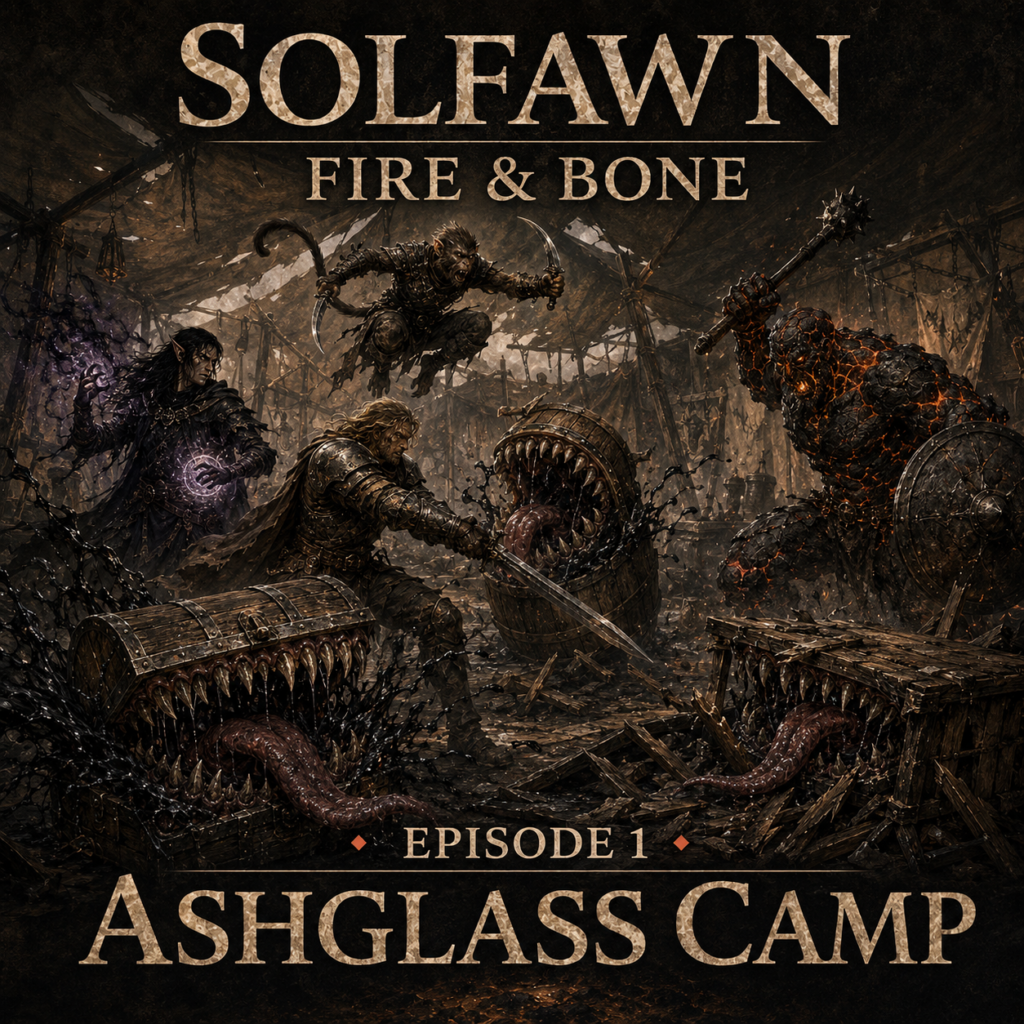
The debris pile did not move. That was the problem. It sat beneath the sagging edge of the laboratory tent, an ugly mound of broken crates, splintered boards, cracked barrels, collapsed shelving, and whatever else the people of Ashglass Camp had decided was not worth taking when they left.
Wyn stood near the pile, studying a half-buried chest with the speculative expression of a man considering whether the world was about to reward or punish curiosity.
Sebastian saw his face. “Don’t.” Wyn did not look back. “That lacks specificity.” “Don’t touch it.” “I haven’t touched it.” “You’re thinking about touching it.” “I think about many things.” “And most of them make trouble.” Wyn crouched beside the chest. Apple’s tail tightened. “Apple?” Sebastian asked. “There is something there,” Apple said. “In the chest?” Wyn asked. Apple inhaled again. “There. And not there.” Wyn stood slowly. The chest opened its eyes. Two cracks in the wood widened, wet and black within, then blinked. The latch smiled. The iron hasp split apart, revealing teeth. Wyn moved with admirable speed for someone who had just been proved wrong in front of everyone. He snapped one hand up and spoke a word that struck the air like flint.
Blue-white force hit the chest squarely. The creature shrieked. The lid snapped open, not on hinges but on a jaw, and a long pink tongue lashed outward where the interior should have been empty. “Mimic!” Sebastian shouted. “Obviously now!” Wyn snapped. The debris pile came alive. Not all of it. That was worse. One crate shifted while another remained dead wood. A barrel rocked once, then stilled. A broken table leg flexed like a finger and vanished under canvas. The chest dragged itself forward on root-like tendons.
Apple launched himself from the basalt shelf. He landed beside a stack of crates and struck the nearest one with both talon blades. Wood split. Nothing screamed. Empty crate. A second crate beside it opened along one side and spat acid into his face. Apple jerked back. The spray caught his shoulder and upper arm instead. Pain flashed hot and immediate, sharper and wetter than fire. His “Which one?” he demanded. “That is the central issue,” Wyn said. Something behind Halen moved. A broken table split down the middle, and a thick tongue snapped out, wrapping around Halen’s thigh. It yanked. Halen’s leg shifted half a step. Only half. The mimic pulled again and discovered that catching Halen was not the same thing as moving him. Halen looked down. “No,” he said. He brought the mace down. The table mimic released him a fraction too late. Its top caved inward with a wet crunch. Halen struck again and again until it became less table, less creature, and more a problem solved with blunt force.
Apple ducked under the acid crate’s next lunge and cut across its soft underside.
This time it screamed. Good. He sprang onto Halen’s back without warning. Halen grunted. “Apple.” “Up.” Halen understood faster than most people would have. He took one step forward and lowered his shoulder. Apple ran along his back and launched over him, flipping through the dust-heavy air. He landed on the acid crate’s back with both blades reversed.
He drove them down. The mimic convulsed. Apple yanked one blade free and stabbed again, lower, where the creature’s motion seemed to begin. Black blood burst hot over his hands.
The mimic collapsed. Behind him, something lashed from the barrel cluster. A tongue snapped through the air where his neck had been. Apple hit the ground, rolled, and came up facing three barrels. All still. All ordinary. All lying. He hated them immediately. Wyn, on the far side of the tent, had backed almost to the laboratory table. The chest mimic came after him in short, dragging jerks. Wyn lifted one hand and whispered.
The sound was intimate and terrible. The chest shivered. Its disguise failed completely. Meat showed through. Wet tendons. A throat. Teeth rooted in gums where hinges should have been.
“There,” Wyn said. Sebastian crossed the space in three long strides and cut downward with the broadsword. The blade bit through the top edge of the open lid and into the mouth beneath. The mimic screamed around the steel.
The chest split. It died badly, twitching in sections, its tongue flopping against the dirt before going still. “I had that,” Wyn said. Sebastian looked at the bisected mimic. “Clearly.” “Eventually.” Apple did not look away from the barrels. Three of them. One had attacked him. Or perhaps more than one. He stared harder. The left barrel’s stain had no smell. That was wrong. Apple moved. The false wine stain opened as a mouth just before he reached it. Too late. Apple struck both blades into the stain. The barrel screamed and unfolded toward him. Its sides split, iron bands snapping outward as muscle expanded from within. Apple pinned it down with his weight, stabbed once, twice, again and again until the false barrel lost shape and became a twitching black mess beneath him.
The fight broke apart into smaller violences after that. A crate near the laboratory table lashed out and struck Wyn in the side. A barrel tried to take Sebastian’s leg. A shelf bit Halen’s calf and was destroyed by the simple method of Halen slamming his leg against the ground until the mimic burst. front. The barrel split between them. Black blood sprayed across Apple’s chest and face. He did not stop. The mimic fell open, but Apple kept striking. Once. Twice. Three times. The barrel still twitched. The flesh still moved. Things that moved could bite. Things that bit could take. Things that took could drag you back to a table or a deck or a place where someone laughed while you screamed.
He stabbed again. A hand closed around his wrist. Not hard. Strong enough. Apple turned with his teeth bared. Sebastian stood there, blood on one side of his face, eyes steady. “It’s dead,” he said. Apple breathed hard through his nose. “It’s dead,” Sebastian said again. The words reached him slowly. The tent returned. Dust. Acid stink. Broken crates. Halen standing nearby with his mace lowered. Wyn holding one hand against his ribs. Dead mimics spread across the debris pile like furniture murdered badly enough to become honest.
Apple lowered the blade. For several breaths, no one spoke. Then Wyn said, carefully, “I think we can safely conclude the debris pile was not abandoned.” They searched slowly after that. Every crate was struck before touched. Every barrel opened from a distance. Every piece of furniture treated as guilty until proved merely useless.
Beneath the mimic nest, buried under broken boards and matted canvas, they found gold, gems, two healing potions, and two dark metal armbands etched with matching marks that seemed to shift slightly when Apple looked at them too long.
Magic clung to them. Wyn took one without touching it directly. “Paired enchantment.” Sebastian looked interested despite himself. “For what?” “Coordination, perhaps. Proximity. Shared motion.” Apple looked from the armbands to Sebastian. Sebastian noticed. “What?” “Nothing.” “That was not nothing.” Apple shrugged. Wyn’s mouth tilted. “These may suit you both. Given your growing talent for nearly getting crushed together.” Halen found the ledger entry. It had been buried under the false bottom of a broken supply crate, protected by oilcloth and sealed with string. Wyn read it first. His expression changed. “What?” Apple asked. Wyn did not answer immediately. He read the page again. Then passed it to Sebastian. Sebastian’s eyes moved over the writing. His jaw tightened. “Fishbrook contacts,” he said. Halen looked up. “Names?” “Yes.” “Guild?” “Some. Butchers. Stockyard workers. A carrier. Maybe a buyer.” Wyn took the page back and tapped one line. “And this one appears more than once.” Apple leaned in. “Who?” “Mira,” Wyn said. Sebastian frowned. “Do you know that name?” “No,” Wyn said. “That is why I dislike it.” Apple looked at him. Wyn held the ledger a little closer to the lantern. “A person who appears once in a ledger may be incidental. A person who appears several times without explanation is either important, careless, or bait.”
“Those are bad choices,” Apple said. “They usually are.” Sebastian looked over Wyn’s shoulder. “Does it give a role?” farm tags, the guild-marked apron, the gems, the potions, the armbands, and enough questions to make the air feel heavy.
Then Halen set fire to Ashglass Camp. The laboratory tent went first, its old chemicals hissing and flaring in sharp colors. The butcher tent burned slower, heavy with old blood and thick canvas. The mimic bodies curled as they burned, their false wood skins cracking open to reveal blackened flesh beneath.
Apple stood well back and watched. He did not like the smell. He liked less that some part of him was glad to see the place disappear. Sebastian came to stand beside him. “You alright?” Apple did not answer at once. The fire reflected in his eyes. Somewhere inside it, a dead barrel popped and collapsed. “I do not like furniture anymore,” he said. Sebastian was quiet. Then he said, “Reasonable.” Behind them, Wyn coughed into his sleeve. “For what it is worth, I intend to distrust every chair I meet for the next several weeks.” Halen watched the flames with the same expression he had worn at the wagons. Judgment. But this time, no one told him they might regret the fire. The camp deserved burning. Halen stood until the central pole of the butcher tent collapsed. Only then did he turn away. “Fishbrook,” he said. The word sounded different now. Not like a place on a map. Like a destination with teeth.