Fire & Bone — Chapter II
· Winston Everlast
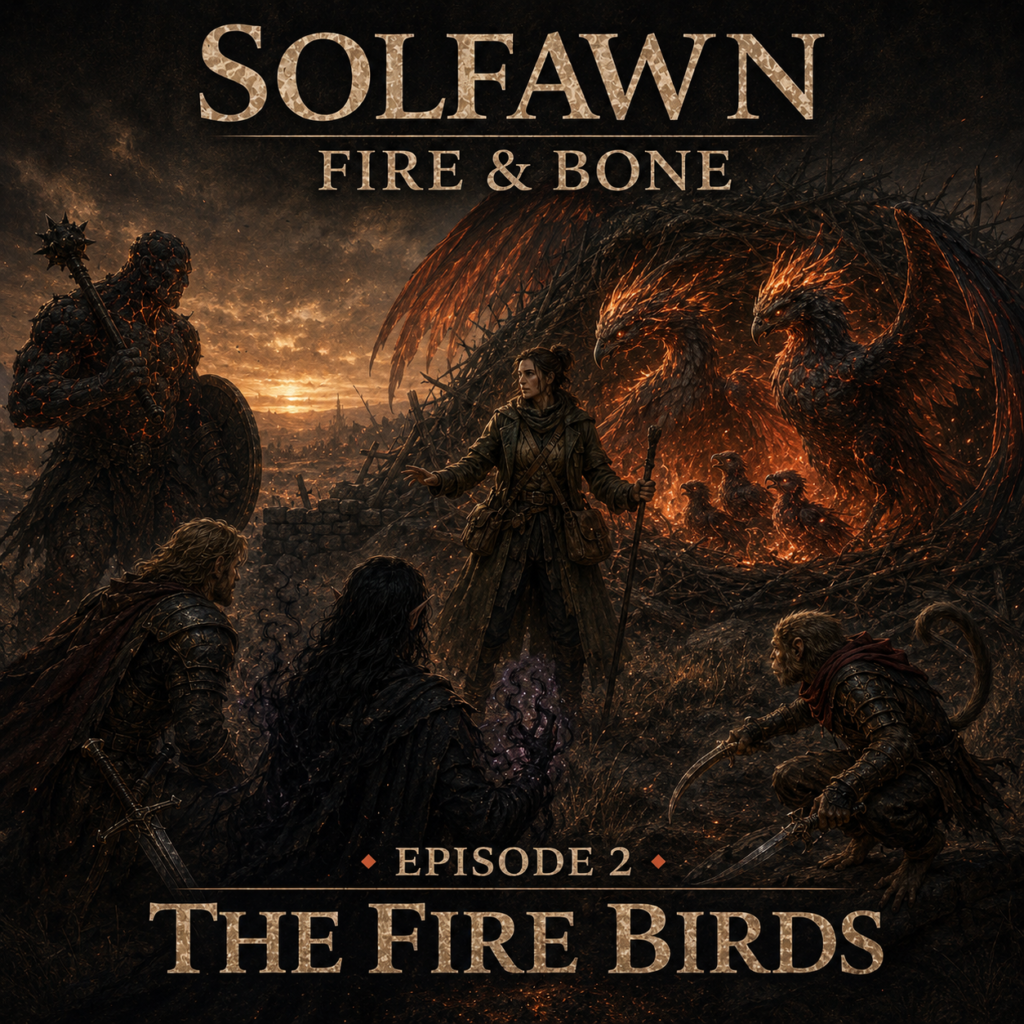
Listen along: Read by Winston Everlast · The Solfawn Deep Dive
Ashglass Camp burned more quietly than Apple expected. He had thought a place like that would scream when fire took it.
Instead, after the first hard burst of strange-colored flame, the camp settled into ordinary ruin.
No revelation came. No confession. Just fire consuming evidence of work already done. They walked until the basin was behind them and the smoke became another stain on the southern sky. No one spoke for some time. That suited Apple. His shoulder ached where the acid had struck. His foot hurt where the ground had bitten through the wrapping. His hands still smelled faintly of mimic blood despite the amount of dust he had rubbed into the fur trying to clean them.
A loose crate sat beside the road where some old caravan must have dropped it seasons ago.
Apple stopped. The crate did not move. He stared at it anyway. Sebastian followed his gaze. “It’s a crate.” “That is what it wants us to think.” Wyn, walking ahead with his copied notes tucked into his satchel, did not turn around. “I support the suspicion.” Sebastian sighed. “You too?” “I have always distrusted containers. Today merely gave my prejudice teeth.” Halen walked over to the crate and struck it once with the head of his mace. It shattered. Wood fragments scattered across the dust. Apple looked at the pieces. “That one was innocent.” Halen resumed walking. “Now we know.” By late afternoon, they found a dry cut in the stone that gave some shelter from the wind. They made camp without much discussion. Wyn copied the Fishbrook names a second time onto a smaller scrap, then sealed the original ledger entry in oilcloth. Apple watched the movement of his pen from the far side of camp while pretending not to.
Wyn noticed anyway. “You may sit closer if you intend to glare at the alphabet.” “I am not glaring.” “You are.” “I am watching.” “The alphabet finds the distinction subtle.” Apple came closer and crouched beside the low lantern. Marks. Lines. Names. Danger made flat. Wyn tapped the top of the copied list with the end of the pen. “These are the names from the ledger. We will need to recognize them.” Apple looked at the first word. “Too many.” “Names tend to be inconsiderate that way.” “Mira is short.” “Yes.” Apple looked up. “That one matters?” “We do not know.” “You said it appears more than once.” “That means it may matter. It may also mean someone named Mira was very good at ordering grain or very bad at hiding involvement.” Apple frowned at the word. Mira. Four marks. He could remember four marks. Wyn reached into his satchel and withdrew the two armbands taken from the mimic hoard. Sebastian looked up. “You figured them out?” “Partly.” “That usually means no.” “That usually means I understand enough to be interesting and not enough to be blamed if something unexpected happens.” Halen gave him a flat look.
Apple looked away. “No.” Sebastian tilted his head. “I didn’t say anything.” “You were going to.” Wyn held out one armband toward Sebastian and the other toward Apple. “You two already do this.” Apple took one armband mostly so Wyn would stop holding it at him.
Sebastian took the other. Apple slid his over his left forearm. The band tightened before he could adjust it. The metal warmed. The markings flared once, pale and quick, then settled into a dull line of light before fading. Across from him, Sebastian’s band did the same. For a heartbeat Apple felt something. Not a thought. Not Sebastian’s mind. Nothing so intimate or offensive. Position. The exact angle of Sebastian sitting across the fire. The weight of the sword over his knees. The distance between them not as sight measured it, but as the body might understand a branch, a wall, a leap, an ally.
Then it was gone. Apple pulled at the armband. It did not move. “I dislike it.” Wyn leaned closer. “Pain?” “No.” “Burning?” “No.” “Whispering voices?” Apple looked sharply at him. Wyn lifted both hands. “A standard question.” “No voices.” “Good.” Sebastian flexed his arm. “I felt where he was.” Apple pointed at him. “Do not do that.” They ate. It was not good food. Unk would have been insulted by it, probably loudly. But it was hot. Apple ate cautiously, checking once beneath the bowl.
Sebastian noticed. “The bowl is not a mimic.” “You do not know that.” “It is full of stew.” “That could be part of the disguise.” Wyn set his own bowl down and stared into it. “I hate that this is now a reasonable concern.” Halen picked up his bowl and tapped it with one knuckle. Ceramic rang dully. “Safe,” he said. After dinner, they talked about the mimics because not talking about them had become worse. Halen had never seen one before. Apple had not either. Sebastian admitted he had read about them in a broadsheet. Wyn looked delighted. “Of course it was.” “It was useful,” Sebastian said. “It said treasure chests might eat people?” “Yes.” “And you retained that?” “I did.” Sebastian leaned back against his pack. “There was a series.
Adventurers. Cursed ruins. Talking skull. Mimic queen.” Apple looked at him. “Mimic queen?” “I was young.” “That does not explain reading it.” “It explains enjoying it.” Wyn explained that mimics were not rare in the way people wished they were. Old ruins, abandoned camps, treasure sites, battlefields, wizard cellars, places with enough death and magic and foolish hands.
Apple went very still. “They are everywhere?” “Not everywhere,” Wyn said quickly. “You said everywhere.” “I said not rare.” “You said everywhere.” Apple looked at the cooking pot.
It struck the side with a metallic clank. The pot did not move. “Safe,” Halen said. The next morning brought no attack. No storm. No burning herd. No furniture with teeth. That felt suspicious, but they accepted it. By afternoon, the road climbed through a shallow pass where the stone walls on either side were streaked with black glass and red mineral lines. The wind came through the pass from the north.
Cool. Actually cool. Apple stopped walking before he meant to. The air touched his face without heat in it. Not cold, exactly. But clean of furnace. Wyn lifted his face to the wind. His dark hair streamed back from his cheeks. “Wind Hollow Pass.” Beyond the pass, the land opened into the plainlands. Dry grass moved in long bands. Scattered trees leaned under the wind. Farther north, a faint smoke haze lay near the horizon, but the world no longer seemed to be smoldering from beneath.
Halen did not look relieved. If anything, he looked less comfortable. Apple noticed. “Too cold?” “No.” “That means yes.” Halen continued walking. “It is cooler.” “That is what cold is.” Near the northern mouth of the pass, they found remnants of creatures. A leg joint blackened and cracked. A wing-like membrane turned brittle as old parchment. Clumps of fused feathers and bone. Something with too many teeth frozen open in a final snarl.
Sebastian crouched near one. “Stopped by the cold?” “Or the change,” Wyn said. Apple sniffed carefully and regretted it. “Malrick’s.” They walked another hour north before making camp. Night came colder than Apple expected. Halen sat slightly apart from the fire, looking betrayed by the weather. Wyn, who had taken out the copied ledger notes again, glanced at Apple. “Lesson?” Apple considered refusing. He was tired. His foot hurt. His shoulder hurt. The armband still made him too aware of where Sebastian was whenever they moved too close together.
But the word Fishbrook had begun to stay in his mind. So had Mira. Marks meant places. Marks meant names. Marks meant the difference between being told what mattered and seeing it himself. He moved closer. Wyn wrote Apple’s name in the dirt with the end of a stick.
APPLE. Apple stared at it. “That is not my name.” Wyn looked up. Sebastian became very still. Halen, too, though in his case the stillness was heavier. Apple had not meant to say it like that. He touched the cord at his neck where Koruma’s ring rested beneath his tunic. Saru was his name. Sa before that. Saru of the Ru Temple. Apple was the pirate name. The survival name. The name that had carried him through East Haven, Stonegate, the Wall, Glarus, Ashglass, and now toward Fishbrook.
Both were true. That was the problem. Wyn smoothed the dirt with his palm. Then he wrote again.
SARU. Apple stared at the marks. His throat tightened with such sudden force that he hated Wyn for doing it and was grateful in the same breath. “That says Saru?” “Yes.” Apple touched the first mark.
“S.” “Yes.”
It was too small. Too small to hold his father’s hands, his mother’s voice, the Ru Temple canopy, the Heart Stone hidden in the tree, the tail rings, the fire, the sea, the boy who had existed before a pirate threw him an apple and laughed.
Too small. And yet there it was. A name trapped in dirt by a stick. Apple reached out and rewrote the first letter beside Wyn’s version.
Badly. Wyn did not correct it immediately. Good. Apple wrote the next. Then the next. Then the next.
SARU. Ugly, but readable. “That is your name,” Wyn said. Apple kept his eyes on the dirt. “One of them.” “Yes.” Halen’s voice came from across the fire. “Names can change.” Apple looked up. Halen was watching the flames, not him. “They can also remain,” Halen said. No one spoke for a moment. Later, when the others were drowsy and the fire had burned low, Apple practiced the invisible helper spell. He had meant to lift a small pebble and drop it near Sebastian’s boot.
Only near. The magic tugged strangely, perhaps because he was tired, perhaps because the armband had made him too aware of Sebastian’s position. The pebble rose from the ground, wobbled invisibly through the air, and struck Halen squarely on the side of the head.
Not hard. Enough. Halen turned slowly. Apple looked down at the dirt. Sebastian coughed. Wyn covered his mouth with one hand, which helped not at all because his shoulders were already shaking. Halen looked from Sebastian to Wyn to Apple. Apple did not make eye contact. “Wind,” he said. Sebastian made a strangled sound. Wyn lost the fight first. His laugh came out sharp and badly suppressed. Sebastian followed, quieter but helpless. Even Halen’s expression shifted, though only by a fraction.
Apple continued looking at the dirt. At SARU. At APPLE, which Wyn had written again beside it. Two names. One badly behaved spell. A cold night beyond the Blacklands. It was not safety. But it was close enough to rest beside for a little while.
⁂
The next day gave them distance. Not comfort. Distance. By noon, the Blacklands had fallen behind them. Trees began appearing with greater confidence. Not many, and not large, but enough that the land no longer seemed ashamed of being alive.
Apple found himself watching the branches. They were poor branches. Low, wind-shaped, dry in places, badly spaced for travel, and not worth climbing unless a person had no standards. But they were branches.
Sebastian noticed. “You look less angry at the ground.” “The ground is behaving better.” “That helps.” “It should continue.” By mid-afternoon, the road dipped into a shallow stretch of scrubland and then rose again toward a broken line of trees.
Wyn looked up at the tree. “Fire from above.” Apple found tracks beneath the burned branch. Three forward toes. One back. Claw marks curved at the tips. “Bird,” he said. Sebastian came over. “That large?” “Larger.” “How much larger?” Apple looked toward the scorched branch, then at another burn mark farther away, higher in a second tree. “Large enough.” They followed the tracks because the tracks crossed the road, and because every sign of Malrick’s work seemed to become worse when ignored.
The land opened again near evening into a wide shallow field bordered by thin trees and old stone walls half-swallowed by grass. More scorch marks blackened the area, but no fire burned now. The air shimmered in a low place ahead where the ground dipped behind a fallen tree.
Halen raised one hand. They stopped. Apple smelled them before he saw them. Hot feathers. Charred dust. Animal musk. And something else beneath it–something young and sharp and frightened. A woman stood at the edge of the shimmer. She was human, perhaps middle-aged, perhaps younger and weathered by roadwork. Her hair had been bound back under a faded scarf, and she wore a long field coat patched at the elbows and hem. A satchel hung at her side. A walking stick rested in one hand, though the way she held it suggested it could become a weapon if needed.
Beyond the shimmer, two large birds crouched in a hollow with their wings partially spread. Their bodies were lean and hunched, their necks long, their beaks hooked and black at the tips. Feathers lay in dark layers along their backs, but under those feathers moved a red-orange glow like banked coals beneath ash.
Their wings were curved inward around a cluster of smaller birds. Young ones. Nine, Apple counted. Maybe ten if one was hidden beneath the others. They huddled together under the shelter of the adults’ wings, awkward and downy, though even their down smoked faintly at the tips.
They were ugly. They were also babies. That made the whole thing more difficult. Halen saw them. His expression closed at once. “Malrick’s,” he said. The woman turned. “Don’t come closer.” Halen stepped forward anyway. The woman shifted her walking stick across her body. “I said don’t come closer.” Halen stopped, but not because she had ordered him. Because Sebastian had moved one hand slightly, not touching him, only reminding him that the birds were not charging and the woman had not attacked.
“You’re frightening them,” she said. Halen looked past her to the hollow. “Good.” The woman’s eyes narrowed. “Good?” “They should be frightened.” “They are animals.” “They are abominations.” The nearest adult bird lifted its head. Its eyes glowed dull orange. The woman raised one hand toward the hollow without looking away from Halen. “Easy.” To Apple’s surprise, the bird lowered its head a little. Not tame. But listening. Sebastian stepped forward carefully. “We don’t want trouble.” “That depends,” the woman said, still watching Halen, “on whether your friend believes himself appointed judge of every living thing he dislikes.”
“They have no proper range,” Halen said. “Because someone made them?” “Yes.” “Then your quarrel is with the maker.” “My quarrel is with what the maker leaves behind.” Zabba’s face hardened. “Convenient.” Halen’s voice lowered. “You do not know what we have seen.” “No,” she said. “I know what I am seeing.” One of the little birds stumbled out from under the wing, pecked at the dirt, then sneezed. A tiny puff of smoke came out. Sebastian made a sound very close to sympathy before catching himself. The adult bird nudged the chick back under the wing with the side of its beak. Halen did not soften. “They will grow,” he said. “Yes,” Zabba said. “They will hunt.” “All animals eat.” “They will burn fields.” “Perhaps. Perhaps not.” “They will kill people.” “Perhaps. Perhaps not.” “That is enough.” “No,” Zabba said. “It is not.” Halen pointed toward the birds. “There is a rock in their hearts.” Zabba turned her head slightly. “And in yours.” Apple’s ears went flat. Sebastian breathed in sharply. Wyn’s expression changed in a way that meant even he had not expected that exact strike. Halen went completely still. “You are Emberkin,” she said. “You live. You think. You choose. Yet I have heard people call your kind unnatural. Dangerous. Responsible for old disasters you did not personally make. Should I believe them because they are afraid?”
Halen’s eyes burned. Apple could feel the heat from where he stood. Wyn stepped in then, which was either brave or foolish and probably both. “Zabba of Fishbrook,” he said. “You said you are with the Naturalist Society.” Her eyes flicked to him. “Yes.” “Then you know the region. And its people.” “Some.” “We found Ashglass Camp.” That changed her. “You were at Ashglass?” “Yes.” Zabba looked from him to the others, reassessing the dust, the burns, the blood still on their clothes, the exhaustion beneath their stance. “What did you find?”
Sebastian answered. “Butcher hooks. Feed stages. Farm tags. Pyre Dust. Black Scent. A stockyard sketch. Names in a ledger.”
Zabba’s face tightened with each item. Wyn watched her. “We are going to Fishbrook.” “That much is obvious.” “We could use someone who knows where not to walk in shouting.” Zabba looked at Halen. Halen looked at the birds. The largest adult bird lowered its head farther, sheltering the young more completely beneath its wing. Smoke curled around its beak. It did not attack.
Zabba said, “If you attack them, I will not help you.” Halen’s voice came rough. “They should be destroyed.” “Maybe someday they will have to be,” Zabba said. “But not for keeping babies warm in a field.” At last Halen stepped back. Not much. Enough. Sebastian let out the breath he had been holding. Then Halen turned away from the hollow. “Lead us around them.” Zabba studied him carefully.
“Yes.” “That’s where we’re headed.” “So you said.” “We have names from the ledger.” She did not answer immediately. Wyn came up on her other side. “Would the Naturalist Society help us identify them?” “That depends on the names. And on whether they are implicated.” Sebastian said, “We need to know where altered livestock would move through the city.” “Western stockyards,” Zabba said at once. “Near Marshgate, if they wanted volume and smell enough to hide in.” Apple’s nose wrinkled in anticipation. Zabba noticed. “You’ll hate it.” “I already do.” For the first time, she almost smiled. Almost. Wyn drew the copied list from his satchel. “Do you recognize any of these?” Zabba took the page and read while walking. Her face changed when she reached one name. Not fear. Not guilt. Recognition. “Why is Mira on this list?” she asked. Wyn’s eyes sharpened. “That is what we hoped you might tell us.” Zabba stopped walking. Behind them, far across the field, one of the fire birds gave a low call.
Not warning. Not attack. Only sound. Zabba looked back toward the hidden hollow, then north toward Fishbrook. When she spoke again, her voice had lost its field-observer distance. “You had better tell me everything you found at Ashglass.” Halen said, “We already did.” “No,” Zabba said. “You gave me a list. That is not the same thing.” The path turned toward Fishbrook, and this time Zabba walked faster.
⁂
The Scarlet Wizard Inn stood at the corner of two narrow streets beneath a faded sign depicting a wizard in red robes raising a tankard instead of a staff.
Apple approved immediately. The painted wizard’s staff had been replaced with a frothing mug so many years ago that the original outline still showed beneath the newer brushstrokes.
The building was three stories of dark timber and pale plaster, old enough that parts of it leaned in directions architecture probably had not intended. Flower boxes sat beneath several windows. Warm light spilled from the common room. The smell drifting through the open door carried bread, stew, ale, woodsmoke, and only a faint trace of livestock.
Apple drew a deeper breath than he had anywhere near the western side of the city.
“See?” Wyn said. “Civilization.” Apple looked back toward the western side of the city. “I remain unconvinced.” Inside, the inn was crowded without being packed. Merchants occupied several tables. A pair of drovers argued over prices near the hearth. Someone played a stringed instrument badly enough that Apple suspected it was intentional.
The innkeeper, a broad woman with silver-threaded hair and the expression of someone who had survived decades of travelers, looked up as they entered.
Her eyes moved across the group. Apple. Wyn. Sebastian. Halen. “Rooms?” she asked. “Yes,” Sebastian said. “How many?” Apple opened his mouth. Wyn spoke first.
“Three rooms,” Sebastian said. “We will determine sleeping arrangements ourselves.” “A wise compromise,” the innkeeper said. Apple pointed at Wyn. “He steals blankets.” “I do not.” “You absolutely do.” “I reclaim blankets abandoned through poor sleeping discipline.” “That is stealing.” The innkeeper accepted payment, slid three keys across the counter, and moved on to the next customer before either of them could continue. Keys changed hands. Food was ordered. Baths arranged. The group settled at a table near the wall while bowls of stew and fresh bread arrived. Apple attacked the bread with the focus of a man correcting a personal injustice. Wyn made notes between bites. Sebastian reviewed their plans for the following day. Halen listened in silence. The conversation drifted from the investigation to travel stories, then to an extended argument about whether a horse could be considered intelligent if it consistently ignored its owner.
Apple maintained that many horses were making reasonable decisions.
Wyn disagreed on principle. Eventually the food disappeared, the common room began to thin, and fatigue caught up with them. Sebastian set down his cup. “The Naturalist Society will not speak freely to all of us at once,” he said. “Too many unfamiliar faces. They’ll close up before we’ve asked a single question.”
Halen glanced up from his bowl. “You’re thinking two,” Wyn said. “I’m thinking two,” Sebastian agreed. Apple looked between them. “And which two?” Sebastian looked at Wyn. Wyn looked at Sebastian. “Us,” Sebastian said. Halen said nothing. His expression did not change, which Apple had learned was its own kind of answer. “Zabba already knows Wyn,” Sebastian continued. “Or knows of him, at least. That’s enough to get us through the door. The guild will talk more freely without—” he paused. “Without a larger party.”
“Without Halen,” Apple said pleasantly. “Without either of you,” Wyn said. Apple set down his bread. “I see.” “The western stockyards,” Sebastian said. “Someone should look at them before we go to the guild. Zabba said near Marshgate. You’d know what to look for better than we would.”
Apple considered this. It was, he admitted to himself, not an unreasonable division of labor.
He did know what to look for. He also knew he would hate every moment of it.
“Fine,” he said. “But I am registering my objection to the smell.” “Noted,” Sebastian said. Halen pushed back his chair. “Then it’s settled. Wyn and Sebastian to the guild at first light. Apple and I take Marshgate.” No one argued. The common room had gone quiet around them. Somewhere above, a floorboard creaked and was still. Apple picked up the last of his bread, ate it slowly, and decided that was probably as good an ending to the evening as any.